# Can You Run a Stick Welder On a Generator?
Last updated: October 2026
A fence-line repair story opens the subject: half a mile from the nearest outlet, wind-fallen gate to rehang, and a 140-amp stick machine on the tailgate beside a borrowed 5,500-watt portable generator. The welder lit on the first scratch — 6011 at 90 amps, arc crisp, beads tying into rusted hinges like the mains supply was fifty feet away instead of fifty miles. Two hours later a neighbor arrived with an inverter MIG machine and the same generator: it tripped the breaker on first arc start, hummed the generator into a stumble, and went home with an empty bottle of gas and a lesson about why stick and generators are old friends while wire-feed and generators are still negotiating.
So — can you run a stick welder on a generator? **Yes — and stick is arguably the most generator-friendly welding process there is, provided three things line up: sustained output** (the generator’s rated watts must cover the welder’s draw at your welding current — surge watts only carry the arc strike, not the puddle), power quality (transformer stick machines are content on rough, wavy generator power; inverter machines and electronics want cleaner sine waves and stable frequency), and rod-and-settings sense (electrodes that start easily and tolerate voltage sag — the 6011/6013 family — make small generators look heroic, while finicky low-hydrogen work exposes every weakness in the supply chain). Dedicated engine-driven welders exist precisely because this marriage is so common — they’re generators and welders designed as one machine — but ordinary portable generators do the job every day on jobsites, farms, and storm-response rigs worldwide. The entire art is matching the generator to the load, the rod to the supply, and the expectations to the physics.
This guide gives the full operating picture: why stick architecture loves generator power (and where other processes stumble); the power-quality vocabulary — rated vs. surge watts, sine purity, frequency drift, and duty cycle — in plain language; sizing math with worked tables (electrode amps → generator watts, input current at 120V vs 240V); generator types ranked for welding (engine-driven rigs, portable conventionals, inverter generators, household standby); rod selection and arc technique tuned for sagging voltage; machine settings and lead management; a troubleshooting table for classic generator-welding symptoms (arc blow, stuttering starts, dimming lights, tripped breakers); fuel, load management, altitude, and duty-cycle discipline; inverter-stick-on-generator reality checks; safety notes covering carbon monoxide, grounding, and wet-weather practice; the myths this pairing generates; field scenarios; the FAQ; and the bottom line. By the end, you’ll be able to size, set up, and run stick on a generator with the confidence of somebody who’s done it for a decade — even if tonight is your first try.
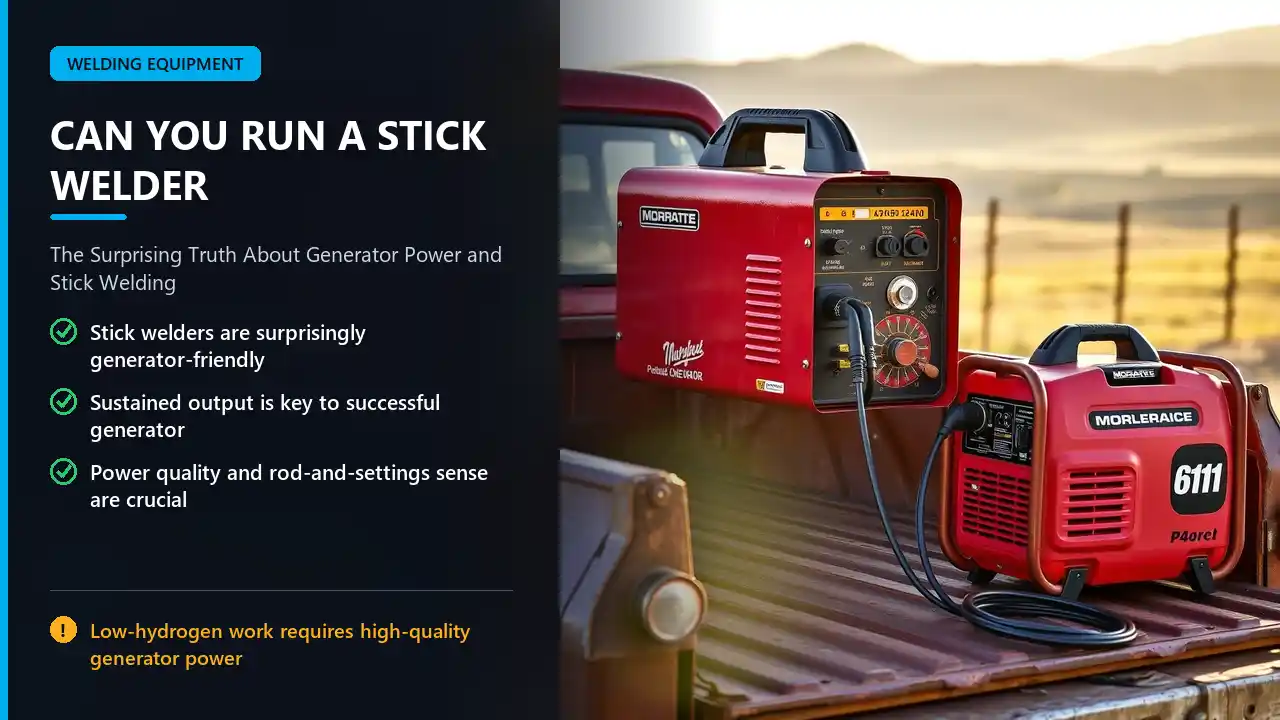
Table of Contents
- Why Stick Loves Generator Power
- Power Vocabulary for Welders
- Sizing Math: Generator to Electrode
- Generator Types Ranked for Welding
- Rod Selection for Generator Welding
- Machine Settings and Lead Setup
- Technique Adjustments for Sagging Voltage
- Troubleshooting the Generator-Welding Rig
- Fuel, Load Management, and Duty Cycle
- Inverter Stick Machines on Generators
- Safety Notes (CO, Grounding, Weather)
- Worked Sizing Examples: Four Real Setups
- Field Rig Build-Out: Kit, Cables, and Carry
- The Generator-Welding Day: Hour-by-Hour Discipline
- The Upgrade Path (When Outgrowing the Portable)
- Process on Generators: Comparison Snapshot
- Twenty Field Rules for Generator Welding
- Pocket Glossary
- Generator Care for Welding Duty
- The 60-Second Diagnostic Flow
- Five Edge Cases, Answered Fast
- Myths vs. Facts
- Real-World Scenarios
- Frequently Asked Questions
- The Bottom Line
- References
- Related WeldGallery Guides
Why Stick Loves Generator Power
The Architecture Argument
A basic stick (SMAW) machine is electrically simple: a transformer or rectifier stepping mains power down to low-voltage, high-current output, controlled by taps or a simple fine-current control. It has no microprocessor, no active electronics in the power path, no arc-starting algorithm asking the supply for a perfect sine wave — it converts whatever comes in and pushes it out through the holder. Generator power’s classic defects — voltage ripple, frequency wobble, harmonic distortion, momentary sag — are things this architecture shrugs off because it was designed decades before clean power was a marketing term (buzz-box context).
Why Other Processes Struggle Where Stick Walks In
- MIG/wire-feed: arc-start inrush, wire-feed motor, and control electronics are power-quality-sensitive; short-circuit transfer reacts to supply dips with bad starts and porosity; inverter MIG machines often demand cleaner waveforms outright.
- TIG: precision low-current arcs on aluminum and stainless want stable supply; power dips show as tungsten contamination and inconsistent starts.
- Stick (specifically): once the arc is drawn, the process is self-regulating enough — manual arc-length control lets the operator compensate for supply sag in real time, a skill every stick welder already has (the comparison).
The Stall Phenomenon (What Actually Happens Under Load)
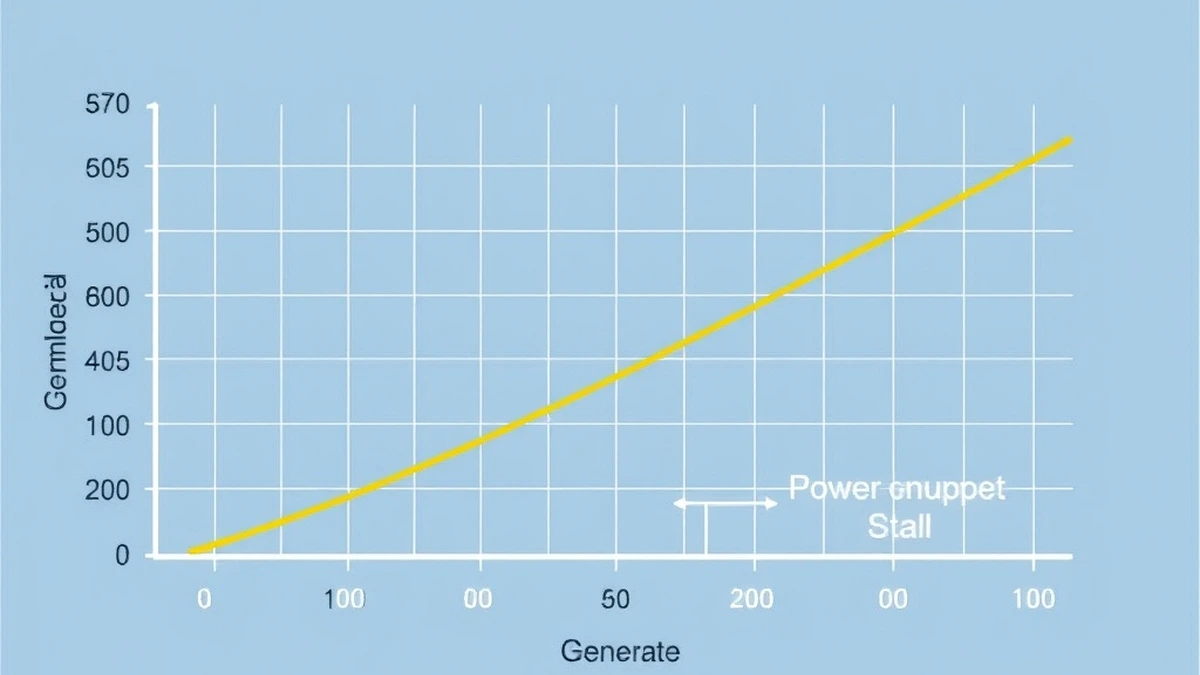
When the arc strikes, generator load spikes instantly — engine droop pulls frequency and voltage down momentarily. A stick welder sees a brief dim; the operator keeps the arc short through the droop and the engine governor recovers in a second. A poorly matched rig stalls or trips instead. The difference between “works” and “stalls” is almost always sizing and rod choice, not the welder’s character — which is exactly what the sizing math exists to prevent.
The Dirty-Work Argument
Stick’s other generator-side superpower: it’s the process least bothered by field conditions — rusty gate hinges, damp posts, wind — because flux coatings handle contamination and the process doesn’t care about gun liner geometry or gas envelopes (rod guide). Remote work pairs field-tolerance with power-tolerance: the two tolerances are the reason the pairing dominates tailgates and storm rigs.
Power Vocabulary for Welders
Rated Watts vs. Surge Watts
- Rated (continuous) watts: what the generator can hold indefinitely — this number runs your puddle. Welding for an hour is a rated-watts exercise, full stop.
- Surge (starting) watts: short-duration headroom (seconds) for motor starts and arc initiation — useful, but it doesn’t weld; a machine that only “matches” at surge watts will bog down mid-bead.
- The rule: size the welder’s draw against rated watts with margin — the 140-amp sizing guide and the 5,000-watt analysis walk the numbers in depth.
Sine Quality and THD
- Clean sine: ideal sinusoidal waveform — inverter electronics and sensitive controls assume it.
- Modified sine / square-ish waves: cheaper generators produce these — transformer stick doesn’t mind; inverter welders, battery chargers, and electronics may behave oddly or refuse to run.
- THD (total harmonic distortion): “waviness” percentage — low THD suits electronics; high THD is tolerable for plain resistive/transformer loads like basic stick.
Frequency Stability (Hz)
Governor quality — 60Hz (or 50Hz regionally) should hold under load. Frequency drift = sloppy governor = arc behavior that wanders when the engine hunts; usually a generator condition issue (governor, maintenance) rather than a welding one.
Duty Cycle (Two Kinds, Don’t Confuse Them)
- Welder duty cycle: minutes per 10-minute period the welder can output before thermal cutoff — unchanged by generator, but your working rhythm interacts with both (duty-cycle guide).
- Generator duty/load rating: sustained output capability — the one the puddle lives in.
Input Side Truths
Welder input current = output watts ÷ efficiency ÷ input voltage. A 140A MIG at full tilt can pull more input current than many 120V household circuits offer; stick machines at comparable output often draw less (better electrical efficiency, no wire-feed motors) — the efficiency ledger of processes.
Sizing Math: Generator to Electrode
The One-Formula Method
Required generator watts ≈ welder output watts × (1 ÷ efficiency) × safety margin (1.25).
For stick transformers, efficiency ~0.75–0.80; output watts ≈ amps × arc volts (~20–26V for typical stick arcs). Worked example — 100A stick arc at 22V: output = 2,200W; input ≈ 2,200 ÷ 0.78 ≈ 2,820W; with 1.25 margin ≈ 3,530 rated watts. A 4,500–5,500-watt generator runs that comfortably (the 5k analysis).
Electrode → Generator Cheat Table (Transformers, 240V class)
| Electrode / target amps |
Arc output (approx) |
Generator rated watts (with margin) |
Notes |
| 1/8″ 6011 @ 80–90A |
~2,000W |
~3,000–3,500W |
Portable 120V machines territory too |
| 3/32″ 7018 @ 90–110A |
~2,500W |
~3,500–4,200W |
Wants stable supply for smooth strike |
| 1/8″ 6013 @ 100–120A |
~2,700W |
~4,000–4,500W |
Forgiving electrode, forgiving rig |
| 5/32″ 6011 @ 120–140A |
~3,300W |
~5,000–5,500W |
Fieldwork standard on mid gensets |
| 1/8″ 7018 @ 130–150A |
~3,600W |
~5,500–6,500W |
Clean power preferred for starts |
| 3/16″ 6011 @ 150–180A |
~4,400W |
~6,500–7,500W |
Serious current = serious generator |
Numbers are planning estimates for transformer machines — always confirm against your welder’s input plate and generator’s rated output. (electrode chart for amperage ranges.)
120V vs 240V: The Input Advantage
A 240V welder draws half the input current of a 120V machine at equal watts — on generator rigs, that’s halved cable heat, better voltage regulation at the receptacle, and less flicker for everything else on the same unit. If your generator offers 240V and your welder accepts it, use it — it’s the single easiest power-quality upgrade in the field (140-amp sizing).
The Margin Habit
Quote needs at 125% of calculated draw, check rated (not surge) output, and never size at exactly the number — first hot day, altitude penalty, dirty air filter, or a second tool on the same generator eats the difference. Sizing with margin is the cheapest reliability you’ll ever buy (the recurring habit of planned headroom).
Generator Types Ranked for Welding
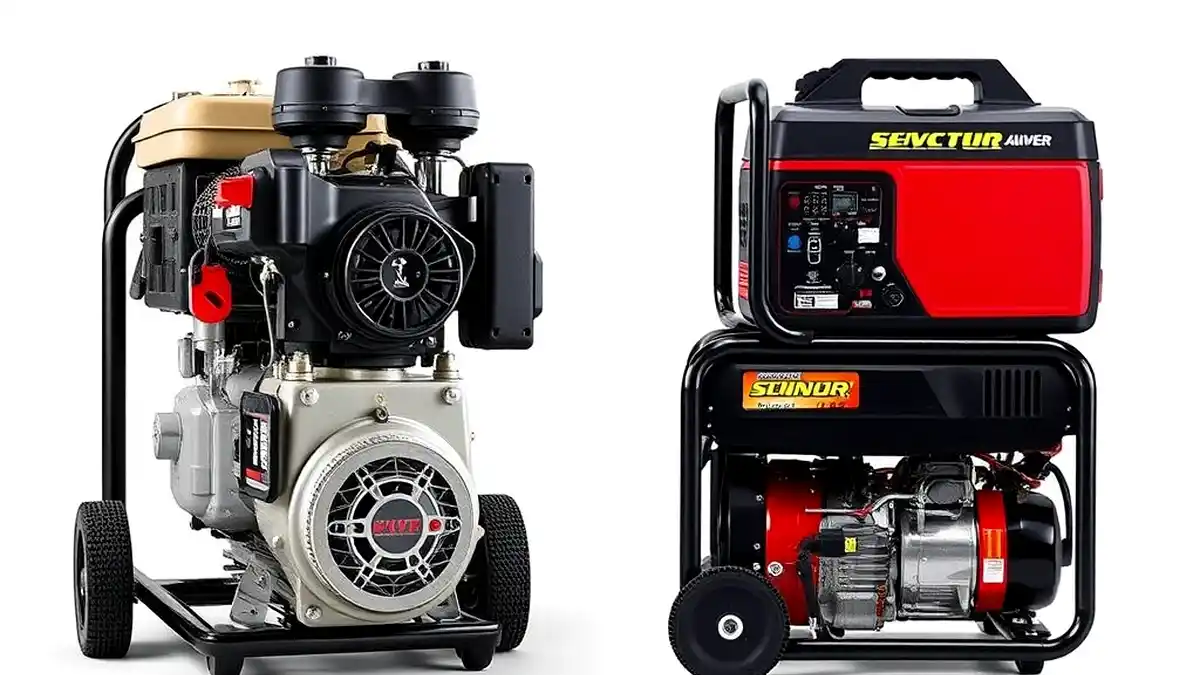
1. Dedicated Engine-Driven Welder-Generators (The Gold Standard)
Purpose-built rigs — welder and generator as one machine (think classic jobsite engine drives): big idle-only-on-demand engines, weld-quality power output on their own terminals, and often auxiliary 120/240V receptacles for lights and tools. Why they win: output engineered for welding load profiles, DC (or AC) welding terminals bypassing household-power conversion entirely, and industrial fuel/cooling/duty design. Trade-off: cost, weight, maintenance footprint. For regular remote welding, nothing else ranks first (the category logic shares DNA with these workhorses).
2. Portable Conventional Generators (The Everyday Option)
Open-frame, gas/diesel, produce 120/240V AC — the borrowed-generator scenario from the opening. Strengths: affordable, available everywhere, sufficient rated watts for mid-amperage stick with the sizing math. Weaknesses: sine quality varies (fine for transformer stick), governor quality varies (arc stability follows), noise, and — critically — the welder and every other tool share the same capacity.
3. Inverter Generators (The Refined Portable)
Cleaner sine, better fuel efficiency, quieter, lighter — excellent for inverter welders and electronics, and perfectly happy driving transformer stick too. Weaknesses: lower rated outputs per dollar, altitude sensitivity, premium repair costs. Ranked third only because of cost per weld-amp; as a power quality source they’re the best portable class here (inverter section for weld-side pairing).
4. Household Standby Generators (The Emergency-Only Answer)
Grid-backup units — large, clean, permanently installed — will run stick during outages, but loading a welding session onto household backup invites transfer-switch limits, load-shedding logic fighting arc draws, and warranty questions. Rank: works in a pinch for a critical repair; not what you plan fieldwork around.
Quick Ranking for the Question Asked
Regular remote welding → engine-driven rig. Occasional fieldwork → sized portable conventional. Sensitive welder + budget → inverter generator. Home repair during outage → standby, carefully. The wall matrix equivalent for power sources (shop-programs logic) — decide once, based on work pattern, not on whatever’s in the shed.
Rod Selection for Generator Welding
The Electrode Family That Loves Sagging Supplies
- 6011 (cellulose sodium): the fieldwork hero — penetrating, fast-freeze, strikes easily and runs well on rough power; its aggressive arc characteristics tolerate voltage droop that makes other rods stutter (6011 usage guide). The fence-repair arc in our opening story: generator’s best friend.
- 6013 (rutile): the beginner-and-small-generator rod — smooth, low-spatter, forgiving arc-length and starts; ideal when the supply is modest and the operator wants the machine’s forgiveness, not a fight (6013 guide).
- 7018 (low hydrogen): excellent when the supply is solid — smooth stable arcs reward clean power — but its strike behavior (stick-prone for novices) and sensitivity to arc instability expose weak generators; run it on engine-driven rigs or high-quality portables, and keep rods properly re-baked/held (7018 guide).
- 6013 vs 7018 vs 6011 on small gensets: pick by priority — starts and penetration on dirty power (6011), smooth appearance on modest current (6013), toughness on dependable supply (7018).
Diameter as a Generator Decision
Thinner rods = lower amps = smaller generator class. 3/32″ and 1/8″ dominate generator work for exactly this reason — a 3/32″ 7018 at 95A and a 5/32″ 6011 at 150A are different generator decisions, not just different weld decisions (electrode chart). When the generator is the constraint, downsize the rod before you oversize the engine.
Consumables Discipline in the Field
- Rod storage: low-hydrogen rods live in portable ovens/rod caddies — damp rods spatter and porosity-blame the generator falsely; cellulose rods (6011/6013) are field-hardy but check coating for damage from bounce.
- Spare count: bring 150% of planned electrodes — supply failures aren’t only electrical (rod-oven discipline).
- Ground clamp and leads: cheap clamp = arc instability blamed on the generator; use heavy leads, clean clamp contact points, ground near the work — the rod-size guide covers lead-sizing logic.
Machine Settings and Lead Setup
Tap and Fine Control (Transformer Machines)
- Start conservative: select a tap near the needed current, then trim with fine control — tap changes under load are for stoppage, not mid-bead experimentation.
- If the arc stutters on strike: drop one tap (lower OCV draws less inrush), strike cleanly, then adjust up if the puddle wants more.
- OCV consideration: machines with selectable OCV allow gentler starts on small generators — lower OCV reduces the surge that stalls the engine (if your machine offers it, use it deliberately).
Lead Physics on Generator Rigs
- Length: long extension leads waste watts as IR drop — the weld end sees less than the machine shows; keep leads as short as the job allows.
- Gauge: undersized extension cords on 120V rigs are a classic “generator can’t hack it” false negative — check the cable before doubting the engine (pressure-drop analogy — delivery losses hide upstream).
- Polarity: DCEP standard for most modern rods; confirm your machine’s output terminals and the electrode’s requirement — reversed polarity on generator rigs shows as penetration and appearance oddities that get misdiagnosed as power problems.
The Setup Sequence (Field Version)
- Generator on level ground, warm-up per manual, rated-output check (sizing).
- Welder into the highest-quality receptacle (240V preferred), no other loads sharing if avoidable.
- Leads out, clamp grounded near work, electrode in holder.
- Tap/fine set for rod (rod choice).
- Strike, hold short through engine droop, weld, recheck load lights/frequency behavior (troubleshooting).
Ten steps, thirty seconds, one clean rig.
Technique Adjustments for Sagging Voltage
The Arc-Length Discipline
Small generators sag under arc load — long arcs make it worse (higher arc volts = higher demand = more sag = worse arc = temptation to lengthen further — the vicious cycle). Counter it:short arc, tight and consistent. Stick technique already rewards short arcs; on generator rigs it’s doubly mandatory.
Riding Through the Droop
At arc initiation the engine dips — keep moving, hold the arc short, and let the governor recover over the first second; pausing in the dip invites rod stick. Practiced welders describe it as “striking through the start” rather than parking at it (opening story).
Current Selection for the Supply
- Choose amps for the generator’s capability first, electrode’s range second — if 130A is the rig’s ceiling, run 1/8″ rods at 115–125A and accept slightly slower travel; forcing 160A on a 4,500W class unit produces stall-trips, not penetration.
- Watch the tell-tales: dimming work lights in step with arc starts = supply nearing ceiling; frequent breaker trips on shared circuits = load-path problem, not welder defect (table).
Bead Management on Variable Supply
- Weave slightly narrower than mains habit — heat input steadies when puddle width steadies.
- Rod angle per electrode rules unchanged; speed adjusts to the arc you have, not the arc you planned.
- Multi-pass beats one heavy pass on small rigs — each pass stays inside the sustainable load window, and interpass cooling helps both welder duty cycle and generator thermal rhythm (duty-cycle guide).
The Feedback Loop
Arc sound (smooth hiss vs. hunting surge), light flicker (steady vs. pulsing), and engine note (loaded hum vs. strain) — three instruments, zero cost. When all three say comfortable, the rig is matched; when any one says stressed, adjust rod/amps/load before adjusting your opinion of the generator (arc-reading culture).
Troubleshooting the Generator-Welding Rig
| Symptom |
Likely cause |
Fix |
| Arc stutters/fails on strike, engine bogs |
Undersized generator or OCV/inrush too high |
Downsize rod/tap; use lower OCV if selectable; confirm rated-watt margin (sizing) |
| Generator trips breaker mid-bead |
Total load exceeds circuit/branch rating |
Weld alone on circuit; reduce amps; check receptacle rating |
| Engine hunts, arc wanders with it |
Governor/maintenance issue (frequency drift) |
Service generator: air filter, fuel, governor check — not a welder fault |
| Rod sticks aggressively on start |
Low supply + high OCV + technique |
Lower tap, cleaner strike, hold short through droop (technique) |
| Lights dim in rhythm with welding |
Supply near ceiling (normal to a point) |
Confirm margin; reduce other loads; accept mild flicker with short arcs |
| Porosity/weak starts on shared circuits |
Voltage drop through undersized cords |
Shorter/heavier leads; dedicated receptacle (lead physics) |
| Arc blow, bead pulls one direction |
Magnetic/grounding conditions worsened by rig grounding |
Reposition ground clamp; check clamp contact; adjust approach angle |
| Welder electronics behave erratically (inverter machine) |
Waveform/THD mismatch with generator |
Check machine’s power-quality requirements; try cleaner generator (inverters) |
| 120V machine fine, 240V trips instantly |
Generator output or receptacle misrated/overloaded |
Verify rated output at 240V; remove other loads; recheck sizing |
| Runs 20 min then welder thermal-cuts |
Welder duty cycle (normal) — or generator thermal derate |
Pace work; clean generator cooling; check altitude/load (duty cycle) |
| Fuel starvation under load (surges then dies) |
Low fuel, venting issue, stale fuel, altitude jetting |
Fuel/vent/altitude service — arc problems that track engine symptoms are engine problems |
The Triage Order (Field Edition)
Check the cheap and nearby first: leads and clamps → circuit and loads → rod and settings → generator condition → then the welder itself. Most “the generator can’t run stick” stories end at step one or two — an undersized extension cord doing its best impression of a weak engine (defect triage).
Fuel, Load Management, and Duty Cycle
Load Management (The Half of Rig Ownership People Skip)
- Welding alone: if possible, dedicate the generator to the welder — lights, compressors, and chargers compete for the same rated watts and quality headroom.
- If sharing is unavoidable: schedule non-critical loads between welds, not during arcs — a compressor kicking at arc-start is how stall-trip stories begin (power basics).
- Receptacle strategy: welder on the cleanest outlet, everything else downstream and supervised.
Fuel and Endurance Math
- Generators burn roughly 0.5–1+ gallon/hour depending on load — welding at 60–80% rated load sits in the thirsty band; plan fuel for the work session plus margin, and carry more than the manual’s ideal-case number.
- Load affects burn: light loads sip; weld-heavy loads drain — fuel planning and sizing planning are the same planning (cost habits).
Altitude, Air, and Maintenance
- Altitude derating: carbureted generators lose output above ~3,000–5,000 ft (varies) — a rig that sized perfectly at sea level may need a smaller rod at 7,000 ft; recheck sizing for your location.
- Air filter and oil: dirty filters and low oil reduce output and stability — field maintenance is weld-quality maintenance on this rig.
- Warm-up: 2–3 minutes before arc work stabilizes voltage and clears the governor into working range.
Duty-Cycle Rhythm
Welder thermal limits and generator fuel/heat limits intersect in your work pace: short multi-pass sequences with natural breaks keep both machines inside design duty; continuous max-current sessions stress both (efficiency guide). The pros’ rhythm isn’t endurance — it’s sustainable tempo.
Inverter Stick Machines on Generators
The Compatibility Question
Modern inverter stick welders are compact, efficient, and precise — and more particular about supply quality than their transformer ancestors:
- Waveform sensitivity: some inverter models specify clean sine / low-THD supplies; crude modified-sine generators can cause erratic arc behavior, error codes, or refusal to start.
- Efficiency upside: input watt draw is typically lower than transformer equivalents for the same output — when the supply is adequate, inverter machines make small generators stretch further.
- The pairing that works: inverter welder + inverter generator (clean waveform, stable frequency) is a premium, quiet, efficient field rig; inverter welder + crude open-frame generator is a coin flip — check both manuals’ power-quality specs before the truck leaves.
Practical Guidance
- Read the welder’s input requirements (min. THD if stated, sine type, voltage window).
- Read the generator’s output description (THD figure, waveform class).
- If both documents say “clean” — pair freely; if either is silent or admits high distortion — test on a coupon session before committing to the job.
- Transformer stick remains the default answer for unknown/generic generator power — that’s not nostalgia, it’s compatibility breadth (why stick).
Safety Notes (CO, Grounding, Weather)
Carbon Monoxide (The Non-Negotiable)
Generators kill more people with exhaust than with electricity. Never run a generator in enclosed orsemi-enclosed spaces — garages, sheds, tents, or against building openings; position exhaust downwind of the work area and the crew; install CO detectors where semi-enclosed work is unavoidable. The fume-awareness framework from welding output applies double to engine exhaust (fume culture) — CO is colorless, odorless, and the generator’s most dangerous output.
Electrical Grounding and Wet Weather
- Ground the machine per its manual — grounding protects the operator path; never defeat three-prong connections or float grounds “to stop nuisance trips.”
- Wet conditions: generator + puddles + weld leads = elevated caution — GFCI protection on 120V circuits where available, dry work platforms, and rubber mats under the operator position.
- Damaged leads: field cables take abuse — inspect before each session; tape repairs are for insulation, not conductor integrity — replace compromised sections.
- Fire load: hot slag, fuel cans, and dry grass/wood — clear the perimeter; a generator rig in brush country carries fuel and ignition within feet of each other.
The Rig Check (Before Every Session)
Level ground → exhaust downwind → grounding intact → fuel cap/vent clear → receptacles dry → leads inspected → circuit breakers known → fire suppression present → crew briefed on CO symptoms. Twenty seconds on the checklist versus the hazards this machine class carries — the same verify-before-trust posture every system in this series demands (the recurring habit).
Worked Sizing Examples: Four Real Setups
Theory clicks when it’s attached to machines people actually own:
Setup A — Farm Gate Repair, 120V Everything
- Welder: 110V transformer stick, 90A max useful output, efficiency ~0.75.
- Math: arc at 90A × 22V ≈ 1,980W out → input ≈ 2,640W → ×1.25 margin ≈ 3,300 rated watts needed.
- Generator: 3,600W rated / 4,500W surge class unit on its own circuit, heavy short cord.
- Reality check: 3/32″ 6011 at 80–90A fits; bigger rods don’t; the fridge stays unplugged during weld sessions. Verdict: matched, with margin (margin habit).
Setup B — Truck-Bed Fabrication, 240V MIG-Inverter + Stick Backup
- Welder: 180A multi-process at 240V; input plate shows ~4,800W at max output; typical session runs ≤60% output.
- Math: realistic average draw ~3,200W → ×1.25 ≈ 4,000W needed for the way it’s actually used; max-output sessions want ~6,000W+.
- Generator: 7,250W rated dual-fuel unit — headroom for max settings and a work light.
- Reality check: stick rods run comfortably in the middle of the envelope; MIG arcs start clean because margin exists to spare (140-amp guide scaled up).
Setup C — Mountain Property, Altitude Penalty Applied
- Welder: 140A 120/240V machine.
- Sea-level plan: 5,500W rated unit, 5/32″ rods at 140A — fine on paper.
- At 7,500 ft: carbureted generator derates ~10–15% → effective ceiling ~4,700–4,900W → rod choice steps down to 1/8″ at ~120A and the work schedule leans multi-pass (altitude note).
- Lesson: the environment is a line item in every sizing calculation — re-run the math for your elevation before buying (sizing).
Setup D — Racing Pit, Inverter Stick on Inverter Generator
- Welder: 160A inverter stick (clean-sine requirement, efficient input).
- Generator: 3,500W inverter-class unit — pure-ish sine, THD in spec.
- Math: typical pit work at 100A ≈ output 2,400W → input ~1,900W (inverter efficiency ~0.85+) → margin ≈ 2,400W — fits with room for the light bar.
- Reality check: pairing logic from the inverter section executed correctly — both manuals checked before the race, not after the first bad start.
The Pattern Across All Four
Each setup starts from actual work patterns, not headline specs: rod amps → input watts → margin → rated output → environment and pairing checks. Four sizes, one procedure — repeat it for any machine that shows up at the tailgate (rapid-list logic).
Field Rig Build-Out: Kit, Cables, and Carry
The Core Kit (What Stays in the Welding Truck)
- Welder (stick first for field work — why), with serviceable leads and a good holder.
- Electrode roster: 6011 (1/8″ and 5/32″), 6013 (3/32″ and 1/8″), 7018 (3/32″ if supply-class supports) — rod logic — in a dry caddy with spare storage.
- Ground clamp: copper-jaw, spring-tight, cable matched to holder cable — replace the mystery clamp that came free with something (lead physics).
- Cables: correct gauge, inspected, coil-rolled not kinked; one heavy extension option for the awkward reach, never a household cord (triage).
- Flashlight/work light on its own small circuit — knowing its draw matters (load management).
The Power Side
- Generator manual (paper copy — phones die at jobsites), rated-output sticker photographed on your phone as backup.
- Circuit tester or meter — confirm receptacle voltage under load, not just at idle (power basics).
- Wheel chocks/leveling for the generator, exhaust extension plan, and the safety checklist taped inside the case lid.
- Fuel cans sized for the planned session plus margin (fuel math).
Carry Discipline (The Layout That Saves Rewelds)
Tools and rods on the welder side, power gear on the generator side, consumables in one labeled box — the physical layout mirrors the setup sequence: power → leads → rod → strike. Pros build kits where nothing is scavenged in the dark — every item has a home, every home gets checked at pack-out. The rig that leaves complete works complete; the rig that “should have a clamp somewhere” returns with a half-finished bracket and a story about missing copper.
The Kit Check (10 Seconds at Pack-Out)
Welder? Cables? Clamp? Rods (dry)? Gloves/helmet? Fuel? Manual? Light? Eight items, one glance at the list taped inside the truck box — the physical version of the wall matrix (checklists).
The Generator-Welding Day: Hour-by-Hour Discipline
Pre-Shift (5 Minutes)
- Walk the site: exhaust path downwind, ground conditions, fire load, work position (safety).
- Generator: oil/fuel/air check, level, chock — quick visual maintenance pass.
- Warm-up to operating temperature — governors behave better warm than cold.
- Receptacle and cord inspection; welder powered on last, after checks (setup sequence).
The Working Rhythm
- First bead = systems test: strike, listen for hunting, glance at lights, confirm margin behavior — the rest of the day runs on this confirmation (feedback loop).
- Cadence: weld in multi-pass sequences with natural breaks — the break serves welder duty cycle, generator cooling, and fuel planning simultaneously (duty cycle).
- Load events: announce shared-load events (“compressor starting”) as crew practice — awareness prevents the surprise stall that ruins a root pass.
- Midday recheck: fuel level, cord heat (warm-but-not-hot = normal; hot = undersized), rod caddy closed, clamp contact cleaned.
Shutdown (3 Minutes, Done Properly)
- Welder off, leads cleared of hot slag paths.
- Generator: no-load cool-down a few minutes before shutdown (turbo/heat soak discipline for diesel; general engine kindness for gas).
- Fuel vent closed, caps on, cords coiled, kit count against the list.
- Swap log/notes: what drew what, any symptoms, any near-stalls — tomorrow’s sizing advice starts in today’s notebook (log culture).
The whole day’s overhead: eight minutes. The alternative — improvising each phase — is how sessions end with dead fuel cans, hot cords, and untraceable arc problems.
The Upgrade Path (When Outgrowing the Portable)
Signs the Portable Class Is the Ceiling
- Rods and amps you want keep sitting above the sizing table ceiling.
- Margin checks keep landing at zero on hot days.
- Shared-load conflicts dominate the day’s planning.
- The weld-vs-packout ratio says this is professional frequency, not occasional repair.
The Three Ladders
- Bigger portable (dual-fuel/inverter class): cheapest jump — more rated watts and/or cleaner sine; re-run sizing with altitude and load if applicable.
- Inverter welder + inverter generator pairing: efficiency and quality upgrade without dedicated-rig weight — the premium field combo (inverters).
- Engine-driven welder-generator: the category designed for this question — welding terminals, industrial duty, no competition for household-style receptacles; the day you buy one, “can a generator run a stick welder” becomes a solved constant (ranking).
The Decision Check (Before Spending)
Recompute the one formula with your actual session amps, list what else shares the load, verify waveform class against your welder’s manual, and check the pocketbook against total cost — machine, fuel burn, transport, and maintenance (cost-habits thinking). Upgrades justified by measured data keep their value; upgrades justified by one bad Saturday rarely do. Whatever ladder you pick, the sizing math, checklists, and safety posture travel with you unchanged — the gear changes; the procedure doesn’t.
Process on Generators: Comparison Snapshot
One table, the whole cross-process question:
| Factor |
Stick (SMAW) |
MIG/Flux-Core |
TIG (GTAW) |
| Power-quality tolerance |
Excellent — simple architecture (why) |
Fair–poor — inrush + electronics sensitive |
Poor–fair — precision arcs want stability |
| Arc-start demand |
Moderate (technique-managed) |
High (inrush + wire motor) |
Low current but sensitive to dips |
| Sine-wave pickiness |
Very low (transformer) |
Medium–high (inverter models) |
Medium–high |
| Field-condition tolerance |
Best — wind/rust/damp (rod choice) |
Poor — gas, liners, clean metal |
Poorest — gas + tungsten discipline |
| Typical generator fit |
Small–mid portables OK |
Mid–large rated watts + clean power |
Clean power + stable supply |
| Operator compensation for sag |
Yes — arc length/amps adjustable live |
Limited — machine compensates or fails |
Limited |
| Verdict on unknown generator |
Default choice |
Verify sizing + waveform first |
Verify supply class first |
Stick’s column is why the pairing has half a century of field history; the other columns explain why their best stories involve bigger, cleaner generators (the comparison for process trade-offs beyond power).
Twenty Field Rules for Generator Welding
Compressed doctrine — the entire guide in one list:
- Size against rated watts, never surge (sizing).
- Add 25% margin — always, before the rod choice.
- Transformer stick is the default for unknown power (why stick).
- Inverter welder? Check waveform class of both machines first (inverters).
- 6011/6013 for modest supplies; 7018 when supply is stable (rods).
- Downsize the rod before oversizing expectations (diameter rule).
- 240V when available — halved input current, better regulation (input side).
- Welder on its own circuit; share only with a plan (load management).
- Short, heavy leads — never the household extension (lead physics).
- Hold short arcs through the engine droop (technique).
- Dimming lights = margin gauge; hunting engine = service cue (table).
- First bead is a systems test, not production (workday).
- Warm up the generator before arguing with it (fuel-ops).
- Re-run sizing at altitude (worked example C).
- Fuel for session + margin; loads burn fuel too (fuel math).
- Log stalls, trips, and swaps — patterns live in notebooks (log culture).
- Exhaust downwind, CO awareness first, every session (safety).
- Grounding and GFCI in wet weather — non-negotiable (safety).
- Kit checks at pack-out, not searches at dark o’clock (build-out).
- When the data says upgrade, take the ladder (upgrade path).
Twenty rules, one laminated card on the generator frame — every one of them earned by somebody’s earlier bad day.
Pocket Glossary
- Rated watts: sustained output — what runs the puddle (power basics).
- Surge watts: short-duration headroom for starts — not a weld rating.
- THD: waveform distortion percentage — inverter-equipment sensitivity metric.
- OCV: open-circuit voltage — pre-arc output; affects strike inrush (machine settings).
- Engine droop: momentary RPM/voltage dip at arc start — ridden through with short arcs (technique).
- Governor: engine speed control — its quality is your frequency stability (troubleshooting).
- Duty cycle: welder thermal rating (minutes per 10) — distinct from generator load rating.
- IR drop: voltage lost in long/undersized cords — the “weak generator” impostor (leads).
- Derating: output reduction from altitude/heat/condition — re-run sizing when it applies (fuel-ops).
- Engine-driven welder: purpose-built welding generator — the category answer to this article (ranking).
- Modified sine: blocky waveform from cheaper inverters — fine for transformers, risky for electronics (inverters).
- DCEP/DEN: polarity options — confirm machine terminals against electrode requirements (polarity note).
Twelve terms, full rig fluency — enough vocabulary to diagnose by phone, order parts by name, and teach the next hire in one break.
Generator Care for Welding Duty
Welding loads are harder on generators than lamp-and-laptop duty — the care schedule follows the load:
Per-Session (The Non-Debatables)
Oil level, fuel quality/vent, air filter condition, cooling vents clear, stable level ground, warm-up before load — five minutes that protect the only power source you brought (workday discipline). Welding’s particulate and field dust clog filters faster than household use — inspect filters at welding frequency, not annual frequency.
Per-Interval (By Hours, Not Calendar)
- Oil and filter changes at manufacturer intervals pulled forward for dusty environments — generator running hot under weld loads makes old oil age faster.
- Spark plug / fuel system: misfires show up as arc-hunting symptoms first; a fresh plug costs less than a misdiagnosed “bad welder” afternoon (troubleshooting).
- Governor and linkage check: loose linkage = frequency wander = wandering arc — tune before blaming rods (power basics).
- Receptacle inspection: tighten, check for heat discoloration (a scorch mark = resistance = lost watts at exactly the moment you need them).
Seasonal and Storage
- Fuel stabilizer for units sitting between projects; stale fuel is the #1 no-start after storage.
- Exercise monthly under some load — batteries, seals, and governors prefer motion to shelves.
- Rod caddy and generator service share a calendar — dry rods and serviced engines arrive at the jobsite together or not at all.
Why Welders Should Own Generator Maintenance
Because on this rig, engine condition is arc quality: filter, plug, governor, and fuel are welding variables — the machine shop’s maintenance culture applies word-for-word to the machine that feeds it (the recurring habit).
The 60-Second Diagnostic Flow
When the arc misbehaves in the field, run this order — stop at the first fix:
- Arc won’t strike / bogs at start → rod down one size, tap down one, other loads off. Fixed? Done. No? → 2.
- Still weak → check cord gauge/length and receptacle under load — swap to short heavy lead. No? → 3.
- Machine-specific? → try a known-good second machine (or the transformer stick) — isolates welder vs supply. Supply side implicated? → 4.
- Engine hunting/flickering → governor/air filter/fuel service (maintenance). Steady but small? → 5.
- Steady but undersized → re-run sizing honestly (altitude? margin? second tool?) — accept the rod-size ceiling or schedule the upgrade (upgrade path).
Five steps, sixty seconds, and — crucially — the flow never starts with “the generator is junk”: cheapest and nearest causes get first claim, exactly like defect triage everywhere else. Keep the flow on a card with the twenty field rules; together they answer every question this article generates before it’s finished being asked (floor-questions culture).
Five Edge Cases, Answered Fast
1. Can I weld while the generator also runs a TIG machine on another job? Only if rated watts cover both draws plus margin, and the waveform suits the pickier machine — in practice, schedule them in shifts; shared live arcs invite quality complaints from whoever’s supply sags first (load management).
2. Inverter generator + old buzz-box transformer stick — good pair? Excellent — clean sine is a luxury the transformer doesn’t need but never objects to; you’ve accidentally built the most compatible class of field rig (ranking).
3. The generator runs 240V but my stick machine is 120V-only. Use the 120V receptacle at correct gauge; know you’ve chosen the higher-draw path — re-check sizing for input current, and never adapt 240V to 120V through sketchy pig-tail adapters.
4. Flux-core (FCAW) on the generator instead of stick? Possible with gasless self-shielded wire — pullability sits between stick and MIG: motor draw + inrush matter, and small generators that welcome 90A stick may resent the wire-feed motor at start (comparison snapshot). Transformer stick remains the forgiving default.
5. Storm work — is AC stick output OK for emergency repairs to a standby system? Welding on or near energized home systems is electrically hazardous — de-energize and follow the arc-welding rod-size and safety logic plus qualified-person rules; the generator’s portability doesn’t relax electrical safety for the building side of the job (safety posture).
Each edge case resolves the same way the core question did — quantity, quality, pairing, margin — the four-word summary this whole guide has been quietly repeating since the first formula (the bottom line).
Final Notes From the Tailgate
Two closing observations that don’t fit any table. First: the notebook compounds. Every rig that gets used in the field produces data nobody else can buy – stall thresholds, rod behavior on this governor, cord performance at forty feet, fuel burn at weld-heavy load. Shops that write one line after each session arrive at their own sizing answers within a month; shops that improvise arrive at anecdotes and buy the wrong generator twice. Second: confidence follows procedure, not horsepower. The crews who look calm on remote sites aren’t calm because their equipment is perfect; they’re calm because the checks were done before the first strike, the fallbacks were planned during the drive over, and the diagnostic flow was already memorized. Hardware can fail a prepared operator for an afternoon; an unprepared operator fails perfectly good hardware every time. Run the formulas, tape the checklists, log the swaps, and let the arc – not the anxiety – decide how the day goes. The generator will keep its opinions about voltage and governor response either way; the only variable you actually control is whether the preparation showed up in the truck. It usually did. Now go strike the arc, and let the notebook remember what the engine learned about your welding. Do that consistently for one season and the next sizing decision, rod purchase, and equipment upgrade will all write themselves from evidence you collected between beads – which is exactly how every well-run field operation has quietly worked since the first generator was rolled out of the truck and grounded for the day.
Myths vs. Facts
- “Generators can’t run welders — different kind of power.” Welders consume ordinary AC power; generator AC runs them daily — the questions are quantity and quality, not kind (power basics).
- “Surge watts are what matter for welding.” Surge covers the strike; the puddle runs on rated watts — sizing on surge guarantees mid-bead stalls (sizing).
- “Stick welders are as picky as MIG on generator power.” Inverted — stick is the least picky major process; its simple architecture and manual arc control tolerate the supply defects that trouble wire-feed and inverter processes (why stick).
- “Any 5,000-watt generator runs any stick welder.” The 5k guide answers precisely: depends on machine input draw, rod amps, and margin — “5,000” isn’t a verdict, it’s one variable.
- “Dirty sine waves ruin welding arcs.” For transformer stick, mostly no; for inverter machines and electronics, possibly — match waveform class to machine class (inverters).
- “Dimming lights mean the generator is failing.” Momentary dimming at arc starts is expected supply behavior under pulsed load; chronic hunting points to governor/maintenance (table).
- “Run the welder and the fridge off the same outlet.” Sharing is possible but subtracts margin — dedicated circuits are how pros keep arcs stable (load management).
- “7018 runs fine on any generator.” It runs best on stable supply — strike sensitivity exposes weak rigs; 6011/6013 forgive more (rod choice).
- “Bigger generator is always better.” Bigger costs fuel, weight, and money — matched-with-margin is better than oversized-on-paper (sizing).
- “Engine-driven welder-generators are just welders with outlets.” They’re purpose-built welding power plants — output design, duty, and reliability class differ from household-style generators (ranking).
- “Welding voids my generator warranty.” Depends on the unit and load discipline — check documentation, respect rated loads, and keep records; abuse voids more warranties than normal use (compliance habit).
- “If it starts an arc, it’s sized right.” Starting and sustaining are different achievements — the puddle, the engine, and the twentieth bead reveal true sizing (margin habit).
Real-World Scenarios
- The fence-line repair (opening, resolved): 6011 at 90A, sized 5,500W portable, dedicated circuit — two hours of hinges and posts with zero drama. The same rig six months earlier failed a MIG job on inrush — the lesson written on the tailgate: match the process to the supply, or the supply to the process.
- Storm-response restoration crew: outage grid, engine-driven rig running lights and welder terminals simultaneously, 6011 for tacked brackets and 7018 for structural touches on the rig’s stable output — the gold-standard pairing doing exactly what its category promises (ranking).
- The borrowed-generator surprise: homeowner’s 3,500W surge-rated unit promised “welder ready” on the box — rated output told a different story; a 3/32″ 6013 at 85A fit within margin while the planned 1/8″ work didn’t. Downsizing the rod finished the job — the diameter-as-generator-decision rule in practice.
- Altitude disappointment: mountain property, sea-level sizing done at the store — output derated by elevation, arcs starving at planned amps. Fix: smaller rods, honest re-derating, and a generator service — the altitude note made concrete.
- The extension-cord culprit: “weak generator” diagnosis corrected in five minutes by swapping a 50ft undersized 120V cord for a short heavy run — the arc perked up like the engine had been replaced (triage order).
- Inverter-on-rough-power failure: compact inverter stick on a cheap modified-sine generator — erratic arc, flickering display, error codes; pairing the same welder with an inverter-class generator cured everything. Manual-reading after the coupon, not after the client complaint (inverter section).
Frequently Asked Questions
Can any generator run a stick welder? Any generator with sufficient rated watts and adequate waveform quality for your specific welder — stick’s tolerance band is the widest of any process, but physics still applies (sizing).
How many watts do I need? Plan from amps: roughly 3,000–3,500W for ~90A stick work, 4,500–5,500W for ~130A class, higher for heavy rods — with 25% margin, against rated output (cheat table).
Will a 5,000-watt generator run a 140-amp welder? The dedicated guide answers fully: likely yes for stick within its amp range at 240V with margin, but check your machine’s input plate — output class alone doesn’t decide.
Should I use 6011 or 7018 on a generator? For rough/small supplies: 6011 (or 6013 for smoothness); for stable, adequately sized rigs: 7018 (rod choice).
Do I need a pure sine wave generator? Transformer stick: no. Inverter welders: preferably yes — check both manuals (inverters).
Can I run other tools while welding? Better not during arcs — shared loads cut margin; if unavoidable, know each tool’s draw and subtract it from rated watts.
Is it safe to weld indoors on a generator? The CO risk makes enclosed-space generator welding genuinely dangerous — ventilate aggressively, monitor exhaust placement, and respect the safety section above all else.
Why does my generator stall when I strike the arc? Inrush exceeds available headroom — lower rod/amp, check OCV, confirm rated sizing, remove other loads (table).
240V or 120V for generator welding? 240V halves input current and improves regulation — use it when both machine and generator offer it (input side).
Does welding damage a generator? Properly sized, within rated load, with clean fuel and maintenance — no; chronic overload, neglect, and dirty power for sensitive loads are what damage units (fuel-ops).
The Bottom Line
Yes — you can run a stick welder on a generator, and you’d be hard-pressed to find a better pairing: stick’s simple, tolerant architecture was practically engineered for imperfect remote power, and the process that fields the dirtiest work brings the least demanding supply expectations. The conditions for success are all knowable in advance: rated watts sized with margin against your actual amps, waveform class matched to your machine type, rods chosen for forgiving starts (6011/6013 family) when the supply is modest, short arcs through the engine droop, dedicated circuits and heavy leads, fuel/altitude/maintenance handled, and safety basics — CO first — non-negotiable. Engine-driven rigs make it effortless; sized portables make it possible, which is why farms, storm crews, fence lines, and race pits have run this combination for the better part of a century. Size it once, log it, trust the checklist — and the tailgate shop stays open no matter where the road or the outage ends (the recurring habit).
References
- WeldGallery — What Size Generator to Run 140 Amp Welder: https://weldgallery.com/what-size-generator-to-run-140-amp-welder/
- WeldGallery — Will a 5000 Watt Generator Run a Welder: https://weldgallery.com/will-a-5000-watt-generator-run-a-welder/
- WeldGallery — Buzz Box Welding: https://weldgallery.com/buzz-box-welding/
- WeldGallery — Which Is Better: Stick Welding or MIG: https://weldgallery.com/which-is-better-stick-welding-or-mig/
- WeldGallery — 6011 Welding Rods Used For: https://weldgallery.com/6011-welding-rods-used-for/
- WeldGallery — 6013 Welding Rod Used For: https://weldgallery.com/6013-welding-rod-used-for/
- WeldGallery — 7018 Welding Rod Used For: https://weldgallery.com/7018-welding-rod-used-for/
- WeldGallery — Electrode Chart for Arc Welding: https://weldgallery.com/electrode-chart-for-arc-welding/
- WeldGallery — How to Increase Duty Cycle of a Welder: https://weldgallery.com/how-to-increase-duty-cycle-of-a-welder-maximize-efficiency/
- WeldGallery — Are Welding Fumes Toxic: https://weldgallery.com/are-welding-fumes-toxic/
Related WeldGallery Guides