How Does a Welding Machine Work? A Complete, Easy-to-Follow Guide
Learn how a welding machine works — from transformers and inverters to arc voltage, polarity, settings and safe…
READ ARTICLE →The gate guard waved the truck through, and Eddie rolled his welding trailer up to the fence line of a job site the size of four football fields — a new equipment barn going up on the edge of town. He had a 140-amp MIG machine chained to the trailer deck and a generator that came with the trailer when he bought it used, rated on the side at 3,500 watts. He fired up the generator, strung out the cord, clamped the machine to a brace, and pulled the trigger on the first root pass. The arc shorted, stuttered, and died. He released, retried, and the machine’s panel flickered like a bad connection at a truck stop. By the third attempt the generator’s overload light was burning steady, and a foreman with a checklist was watching from twenty yards away. That walk across a job site — from “good enough” to “everybody is looking at me and my machine will not hold an arc” — is the real price of undersizing a generator.
Here is the direct answer he needed: a 140-amp welder wants at minimum a 5,000-watt running generator, with 6,000 to 6,500 watts running output as the comfortable, recommendation-size pick. The first part is the floor; the second part is where you stop thinking about partial power and start actually welding like the machine was designed to. The 5,000-watt number appears in the manufacturer guidance, in the sizing charts this article walks through below, and in the sit-side experience of everyone who has ever run a 140-class machine away from a wall socket.
The rest of this article is the engineering behind that answer — what “140 amps” really means at the wall, how the watts calculation works, why the headroom rule exists, what dirty power does to a machine, how altitude and fuel shorten the margin, and how to match the generator’s outlets to your welder’s plug so the whole rig behaves like it was built to work together. Eddie’s story has a happy ending, by the way: he swapped the 3,500-watt unit for a 6,500-watt inverter-style generator, and the same machine that had been dying on him laid down clean beads for the rest of the week. The lesson he bought is the one most people only learn once.
Quick Note: “Surge watts” and “running watts” are not the same number, and generator advertising makes it easy to mistake one for the other. The running watts figure is what welds; the surge figure is the starter-motor moment. Size on running watts, always.
Match your machine’s output class to the row, then confirm the details against your welder’s nameplate before you buy anything.
| Welder output class | Typical input draw | Minimum running watts | Recommended generator |
|---|---|---|---|
| 90–110A (small flux-core / MIG) | ~1,500–2,500W | 3,000W | 3,500–4,000W |
| 120–140A MIG, 120V | ~2,800–3,600W | 4,000W | 5,000–6,000W |
| 140A output, dual-voltage at 240V | ~3,600–4,300W | 5,000W | 6,000–6,500W |
| 180–200A | ~4,800–6,000W | 6,500W | 8,000W |
| 210–250A | ~8,000–10,000W | 10,000W | 12,000W+ |
Your look at that middle row is the whole point of this article. A dual-voltage 140-amp MIG on 240 volts draws roughly 3,600 to 4,300 watts at full output, which puts a 5,000-watt running generator right at the edge of comfortable — functional, but with no fat for surges, extension-cord losses, or a machine at top setting. Step to 6,000 or 6,500 running watts and every one of those corners gets rounded. If the machine runs on 120 volts, the current doubles and the same output needs the bigger side of the range, which is why the 120-volt row lands on the same generator recommendation.
Pro Tip: The numbers printed on a generator’s side — “6,500W” — are almost always the surge figure or the peak, depending on the manufacturer’s honesty. Open the spec sheet in the manual and read the rated running wattage line. That is the number this article uses, and the number that welds.
The “140” in a 140-amp welder is an output figure — the maximum current the machine can deliver to the electrode. It is not, repeat, not the current the machine pulls from the power source. Confusing those two numbers is the single most common reason people undersize generators, and it is the exact trap Eddie fell into when he bought a 3,500-watt unit and trusted the side of the box rather than the nameplate.
Think of the builder as a transformer. It takes high-voltage, low-current power from the wall or the generator and converts it into low-voltage, high-current power at the arc. Welding arcs run hot at around 17 to 25 volts — far below the 120 or 240 volts the machine is fed. A 140-amp machine at 20 arc volts is delivering about 2,800 watts across the arc, and inefficiency in the conversion, the fan, the wire feed, and the control board pushes the wall-side draw meaningfully above that. The nameplate on the back of the machine prints the input requirements in volts and amperes, and that input amperage is the number that sizes a generator or a breaker identically. Our guide to how many watts a welder uses works through this exact math for a dozen machine classes.
The same 140-amp machine in its 120-volt mode draws roughly double the current it draws on 240 volts, which means it draws roughly double the amperage from the generator — though the wattage is roughly the same because half the current at twice the voltage arrives at the same power. The generator cares about watts, the cable and outlets care about amps, and the welder cares about both. A 140-amp welder run on 120 volts through a generator with a 30-amp 120-volt receptacle is limited by that outlet’s rating before the engine even warms up. On 240 volts, the same machine sips current and leaves room for the wide-open throttle the job also wants.
Quick Note: If your 140-amp machine is a 120-volt-only unit, plan on the larger generator even though the output looks modest. The 120-volt side of welding is current-hungry, and an undersupplied 120-volt machine is where the “my welder was fine at home and dies on site” stories start.
The whole sizing question reduces to one formula that never argues: power in watts equals volts times amps. Multiply the machine’s input voltage by its input current and you have its consumption. Everything else — headroom, derating, surge — is margin added on top of that number.
Take a 140-amp machine at full output on a 240-volt line. If the nameplate says 18 amps of input, consumption is 240 × 18 = 4,320 watts. Same machine on 120 volts at the same output draws about 36 amps — 120 × 36 = 4,320 watts again. Same power, double the amperage, and now you see why the generator’s 240-volt outlet is worth hunting for: it halves the current flowing through every foot of extension cable and leaves the generator’s amperage capacity available for the machine’s real draw. The equation works backward with equal authority: a generator rated 5,000 running watts at 240 volts delivers about 20.8 amps of continuous capacity to a 240-volt welder, and a welder drawing 18 to 20 amps sits exactly on that line.
Every generator has two wattage numbers. Running watts (also called rated or continuous watts) is what the set can deliver hour after hour. Surge watts (starting, peak, or max watts) is what it can briefly deliver for a spinning motor’s start-up moment — a compressor jogging to life, a feed motor pulling wire with a cold whip. Welding itself is close to a continuous load with fast variations, so the running figure is the one that keeps an arc alive. A generator that reads “6,500 surge / 4,800 running” will comfortably run a coffee maker all day and will die the first time a 4,000-watt welder demands a sustained bead. Read the fine print, not the bold print.
Short Note: Welding current is famously spiky. A stroking arc, a dirty plate, and a rod shorting across the gap all draw surges of their own above the machine’s average. That is precisely why the running-watt figure needs genuine headroom over the machine’s average draw.
“140-amp welder” is a box that holds very different machines, and the process inside it changes how hard the generator works. A 140-amp class describes the output ceiling, but MIG, flux-core, and stick machines reach that ceiling through such different personalities that the generator size question deserves a process-by-process look before you sign the purchase.
A solid-wire MIG at 140 amps is the most cooperative customer on a generator. The continuous wire feed keeps the arc steady, the settings stay predictable, and duty cycle at moderate output is gentle — the machine sips in bursts and rests while you reposition the gun. Running a 140-amp MIG on a correctly sized 6,000-watt clean-supply generator is one of the most pleasant field-welding experiences you will have, because there is essentially no drama: the feed sets the rhythm and the arc follows. The machines in our MIG welder for beginners roundup list their input requirements explicitly, so you can check each candidate against the wattage math before the purchase, not after.
Flux-core welding — the gasless arc that runs on its own shielding from the wire’s core — behaves harder on a generator than solid-wire MIG at the same amperage, because the arc is hotter and less polite. Machines in the 90 to 140-amp flux-core class draw brisk current when they dig, and they dig exactly when you are fighting wind and a rough site. A 140-amp flux-core machine still fits inside the 5,000-watt floor, but it lives closer to the edge of the envelope than its MIG twin, which is another reason the 6,000 to 6,500-watt recommendation exists. If your machine runs 120 volts and flux-core at full output, the current draw on the 120-volt side is exactly where the largest generator in the sizing range becomes the honest pick. We break down the full field behavior of gasless machines in our 110-volt flux-core welder guide.
Stick welding is the stress test. A cellulosic rod (the 6010/6011 family) wants aggressive, dipping current that spikes and collapses with every movement of the arc, and a transformer stick machine translates that into hard gusts of input draw. A 140-amp stick machine used on its own is inside the generator envelope, but a stick welder run hard at its top settings will pull the generator down in a way MIG never will, and the stuttering-arc symptom of an undersized supply is far more dramatic with a rod in the stinger. If stick is part of your regular on-site work, move up the generator’s size range rather than down, and read our stick welder on a generator guide before you commit to a wattage number.
Quick Note: The process matters as much as the amperage. A 140-amp MIG and a 140-amp stick machine make the same “watts” claim and behave completely differently at the generator’s voltage regulator — plan the rig for the process you will spend your days doing.
The 140-amp nameplate math lands between 3,600 and 4,300 watts, and a 5,000-watt running generator sits above that with honest margin. It genuinely runs the machine. What it does not do is leave room for the realities of field work: a 50-foot extension cord bleeding a volt or two, a warm afternoon that derates the engine, a machine pushed past the “rated” output for a thicker joint, or a second device — a grinder, a work light — riding the same circuit at a less convenient moment. Generators are at their best between about 40% and 80% of their rating, and a 140-amp welder wedged at 75% of a 5,000-watt unit’s output sits in a workable but tense zone.
Bump the unit to 6,000 to 6,500 running watts and the machine drops into the generator’s happy band — output around 60% of capacity, engine never groaning, fuel consumption actually better per unit of work because the set is not straining. That is why the industry-standard recommendation, repeated by equipment suppliers and welding instructors alike, is 5,000 minimum and 6,000-plus comfortable for a 140-amp welder. The difference between the two purchases is measured in pounds and dollars; the difference in confidence is measured in every job you run through it.
Important: If you plan to run the welder and a grinder, a fan, or site lighting from the same generator, budget the other loads into the running-watt total before you choose the set. A 6,500-watt unit with a 4,300-watt welder and a 1,000-watt grinder is already at 5,300 — nearing the set’s own practical ceiling.
Wattage answers “can this generator feed the machine?” A second question — “can this generator feed the machine properly?” — is answered by power quality, and it is the question that separates a great generator from a frustrating one.
Alternating current is supposed to be a smooth sine wave. Conventional generators with mechanically rotating alternators and basic voltage regulation deliver a waveform with kinks and notches in it; the distortion is measured as total harmonic distortion, commonly called THD. A well-regulated home wall socket sits near 3 to 5%. Cheap conventional generators often run 6 to 10% or worse, and the dirty wave shows up in your work as an arc that won’t hold, spatter that mysteriously multiplies, and control boards in inverter welders that behave erratically. Most experts draw the line for sensitive electronics and welding at about 5 to 6% THD; under 5% is comfortably clean, and the modern inverter generators get down near 3% or better, indistinguishable from the grid to a welder’s electronics.
A shop light, a fan, or a battery charger tolerates a rough waveform far better than an arc does. The arc is governed by voltage and current per fraction of a millisecond; a distorted wave chops the power delivery into lumps, and each lump destabilizes the pool. Inverter welders, which convert the incoming sine wave into DC internally anyway, are somewhat more tolerant than old transformer machines in terms of surviving the abuse — but their internal power-supply regulators still live happier lives on cleaner input. When you see forum debates about “this generator won’t weld right,” the culprit is THD more often than wattage, and the fix is a generator whose spec sheet prints a THD number under 5%.
Pro Tip: The specification sheet is the last place a bad generator hides. If the manufacturer prints a THD figure and it is under 5%, buy with confidence. If the sheet does not mention THD at all, assume the worst and set expectations accordingly.
Add a third to the machine’s draw and buy the generator that matches the total. That is the headroom rule. If the welder pulls 4,300 running watts, add 30% and the minimum purchase lands around 5,600 — which is exactly how “5,000 minimum, 6,000 comfortable” becomes the practical wisdom for a 140-amp machine. The 30% buffer covers four things that always eat into a generator’s real output: surge moments, extension-cord voltage drop, warm-weather and altitude derating, and the engine’s own unwillingness to hold rated output for hours at a stretch.
The same margin thinking applies to the generator’s outlets. A generator receptacle rated 30 amps is a hard ceiling on amperage, and a welder that needs 20 amps of 240-volt input fits, while one that needs 28 lives too close to the edge. When a machine and a generator both carry ratings, the lower of the two is the real system capacity. If you are running a dual-voltage 140-amp welder, its 240-volt input around 18 to 20 amps fits comfortably on a 30-amp, 240-volt generator outlet, and that configuration is the cleanest one to plan around.
Quick Note: Headroom is not an invitation to overspend. A 9,000-watt unit for a 140-amp welder is wasted weight, wasted fuel, and extra noise for no benefit. The sweet spot is the machine’s rated draw plus a third, and not much more.
A welding site is rarely just a welder. The run of the day usually includes a grinder for beveling, a compressor for tire pressure or a needle scaler, site lighting as the light fails, and sometimes a small saw for cutting material to length. Every one of those draws from the same tank, and one of them — the grinder — is the nastiest load on a generator after a stick arc.
Angle grinders are current-hungry and unforgiving. A 4.5-inch grinder at hard work draws 1,000-plus watts, and when it loads against a heavy weld, its current surges while its motor lugs. Running a grinder and a welding arc at the same moment multiplies the stress test: two spiky loads on one voltage regulator means the grinder wins the sagging-voltage fight and the arc loses, almost always right at a critical pass. Compressors are the other classic — a tiny start-up surge on load-out, then a steady burn every time the tank refills. The honest budget for a welding site that also grinds is the welder’s draw plus the other running load plus a third, which is why a 6,500-watt recommendation quietly assumes you are not running everything at once.
Pro Tip: Sequence the work instead of stacking the loads. Fabricate and prep with the grinder while the welder rests; weld in clean bursts while the grinder sits down. A generator sized for the welder plus one neighbor-running load is a much smaller purchase than a generator sized for the welder plus every tool simultaneously — and passing the sequencing habit around the crew is free.
A generator’s rating assumes sea level, standard temperature, and running on the fuel it was tuned for. Field conditions bend that rating, and the derating compounds precisely when you are least able to absorb it.
The rule of thumb repeated by every generator manufacturer: the engine loses roughly 3% of its output for every 1,000 feet of elevation, because thinner air carries less oxygen for combustion. A 6,500-watt unit at 5,000 feet is effectively a 5,500-watt unit; at 7,000 feet, closer to 5,100. High heat does the same work from the other direction — a carbureted engine tuned at 70°F runs lean and weak at 95°F, and generator manufacturers derate for ambient temperature as well. If your 140-amp welder lives at altitude or in a desert summer, that margin under the welder’s draw is what keeps the arc alive. Our guide to running a stick welder on a generator covers the same derating math for the bigger machines, and the curve is identical.
Fuel is the least appreciated voltage regulator. Near-empty tanks and stale fuel both degrade voltage regulation, and a generator low on gas leans out and hunts — the output wobbles and the arc follows every wobble. A visible fuel gauge is worth real money on a welding rig for exactly this reason. Dual-fuel machines that run propane or natural gas add another wrinkle: propane delivers slightly less energy per volume than gasoline, which shows up as reduced output on the same engine, so a propane-fed generator’s running-watt rating is a few percent lower than the gasoline figure. Whatever fuel you standardize on, the discipline is the same: check the tank before each session, carry a correct-sized reserve can, and never let the machine run dry mid-pass.
Short Note: Fuel stabilizer is not optional on a rig that sits between jobs. A generator that has to be shaken awake after three months of garage storage is a generator that will let you down at the worst possible moment.
The table below is the one people tape inside trailer lids. It covers the output classes around the 140-amp machine so you can see where your machine sits in context.
| Welder output | Input at 120V | Input at 240V | Minimum running watts | Recommended running watts | Comfortable pick |
|---|---|---|---|---|---|
| Under 100A | ~11–13A | ~6–7A | 2,500W | 3,000W | 3,500–4,000W |
| 110–120A | ~13–16A | ~7–8A | 3,000W | 4,000W | 4,500–5,000W |
| 140A (the machine in question) | ~17–19A | ~9–10A | 4,000–4,500W | 5,000W | 6,000–6,500W |
| 180A | — | ~11–13A | 5,000W | 6,500W | 7,500–8,000W |
| 200A | — | ~13–15A | 5,500W | 7,000W | 8,000–9,000W |
| 210–250A | — | ~16–22A | 7,000W | 10,000W | 12,000W+ |
Read the row for your machine, then read one row up and treat that as the honest minimum if you weld at the top of the dial or work in heat or altitude. The one-row-up habit costs a little more at the counter and buys a lot of quiet confidence on site. If you are still choosing the machine itself, our roundup of the best MIG welders under $500 and the separate look at 110-volt flux-core welders both list each machine’s power requirements so the generator decision comes along for the ride.
Important: Marketing watts are between you and the machine. A unit marketed as “7,000 watts” with a 5,000 running rating behaves exactly like a 5,000-watt generator for welding purposes, regardless of what the decal shouts.
The perfect wattage total means nothing if the generator’s receptacle does not match the welder’s plug. Field power comes in a handful of configurations, and welding on-site turns into an adapter safari in a hurry.
Most mid-size generators carry a 240-volt receptacle rated 30 amps — either the NEMA L14-30 twist-lock or the 14-50 four-prong on larger units. A 140-amp welder at 240 volts draws roughly 9 to 10 amps, which fits either receptacle with enormous room to spare. The plug on your welder’s cord — often a 6-50 or 14-50 in the common configurations — needs a short adapter or a cord-end swap to match the generator’s socket, and the correct path is a purpose-built adapter cable or a proper plug change on the whip, never a chain of household adapters. The wiring side of the same conversation is covered in our welder outlet guide, applied to a building instead of a rig.
A 120-volt-only machine on a generator means the 120-volt receptacle’s amperage is the ceiling, and that ceiling is lower than you want. Most portable generators carry a single 30-amp (TT-30R) RV-style 120-volt outlet or a pair of 20-amp receptacles; a 140-amp welder pulling 17 to 19 amps on 120 volts sits right at the edge of the 20-amp outlets and is the reason the small machine belongs on the bigger generator in the sizing chart. A single TT-30R at 30 amps gives the machine clean headroom on 120-volt welders that draw under 25 amps, so if your rig is 120-volt-only, shop the generator list for the TT-30R configuration specifically.
Pro Tip: Carry the correct short adapter cable for your machine’s plug in the rig — one with proper cord and rated connectors, not the discount-rack three-for-ten set. It is the difference between a two-minute setup and a lecture from the site electrician.
The modern choice is not just brands; it is technology. Conventional generators spin a brute-force alternator and regulate voltage crudely. Inverter generators convert the alternator’s output to DC and rebuild it into a clean synthetic sine wave, which gives them three advantages that matter enormously to a welder and one honest disadvantage.
The advantages: clean power (THD down near 3% or below), better fuel economy because the engine throttle varies with load instead of spinning wide open at a fixed speed, and noticeably quieter operation with lower weight for comparable output. For a welder, the clean-power advantage alone is worth the price difference, because it turns the generator from a potential arc-killer into a neutral supply. The disadvantage is cost and, at the very high end, a ceiling — inverter-driven welder-grade generators above a certain wattage get expensive relative to conventional units. For a 140-amp welder’s 5,000 to 6,500-watt need, modern inverter generators are squarely in the sensible economic zone, and they are what most welding contractors would steer you toward today.
Quick Note: “Inverter” is a technology, not a brand. Any serious specification sheet will say what waveform the unit produces; if the vendor can’t tell you, that is information too.
The scene that opened this article is worth finishing properly. Eddie’s machine that day was a 140-amp class MIG — the kind of unit that lives happily on a 20-amp house circuit in a garage. The fix on site was a 6,500-watt inverter generator with a 22-foot 10 AWG extension cord and the correct NEMA adapter up to the machine’s whip. The difference was immediate and specific: the arc stopped stuttering because the voltage stopped wobbling, the spatter that had been painting his gloves dropped back to normal, and the machine’s internal fan stopped its on-off hunting. What nobody says about welding from a generator is how much of the “average” difficulty disappears when the supply is clean and oversized — the settings go back to what the manual and experience say, instead of what survives a starved power source.
That is the whole argument for the recommended rating, not the minimum floor. The minimum runs a machine; the recommendation lets a machine turn into itself on site. Contractors who weld for a living do not buy the edge; they buy the machine’s full personality. If you are planning the rig before the buy, our guide to whether a 5,000-watt generator runs a welder covers exactly which machines fit under that floor and which exceed it, so you can decide where your money actually lands.
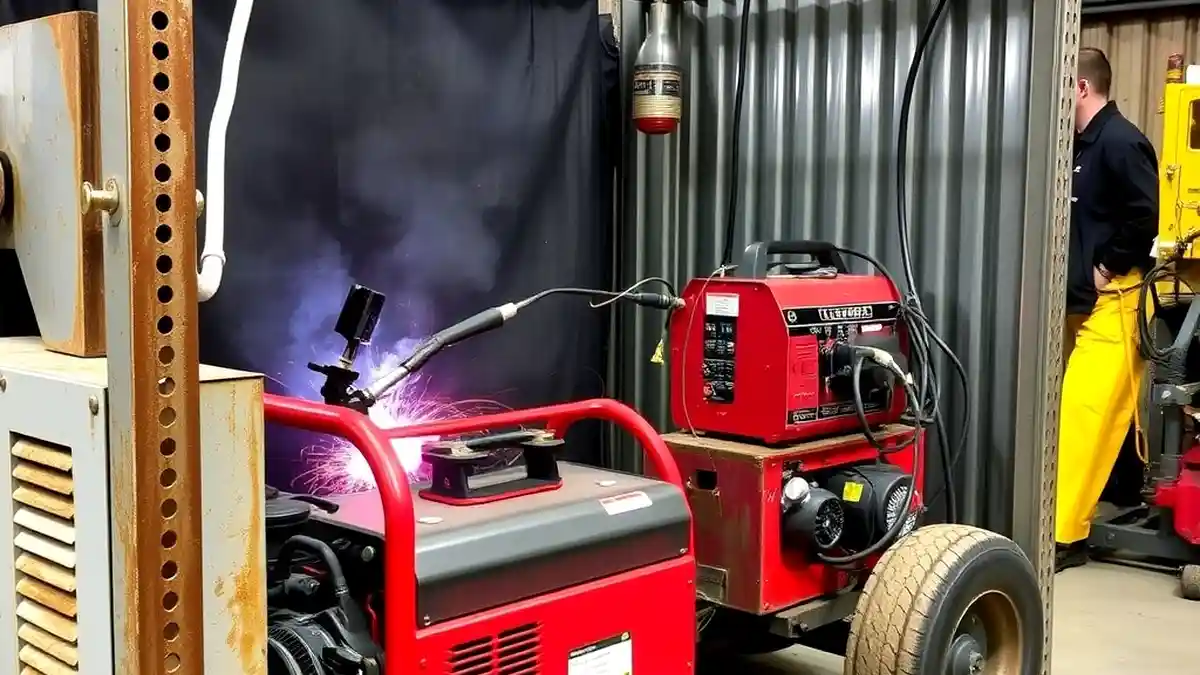
Wattage is bought once; habits are bought every day. The field behavior around the generator determines whether the rig lasts a season or a decade.
Short Note: A generator parked under a canvas cover with its exhaust aimed at a fuel can is a rig failure waiting for a smell. Exhaust placement, cooling airflow, and level ground all belong in the setup checklist as much as the power calculation.
Runtime matters on site because fuel matters on site — every gallon has to get there, and every tankful that disappears early is a bill that arrives inevitably. Generators in the 5,000 to 6,500-watt class run a fairly predictable dance: at a light load (a 140-amp welder at moderate settings, maybe 50% of generator capacity), a typical gasoline unit burns roughly 0.4 to 0.6 gallons per hour; at heavy loading near full throttle, that climbs toward 0.8 to 1.1 gallons per hour. Tank size is the variable that turns the burn rate into a real answer.
| Generator running watts | Tank (typical) | Runtime at light welding load | Runtime at heavy welding load |
|---|---|---|---|
| 5,000W | 4–6 gal | ~8–12 hours | ~5–7 hours |
| 6,500W | 5–8 gal | ~9–14 hours | ~6–9 hours |
| 8,000–9,000W | 6–8 gal | ~8–12 hours | ~5–8 hours |
Read the runtime column the way a contractor reads it: hours per tank at the load you actually run, times how many tanks you are willing to carry, equals whether the rig survives a full workday without a fuel run. Slightly larger generators do not consume proportionally more fuel because they sit lower in their own load curve doing the same work — a 6,500-watt unit welding a 140-amp bead at 60% of its capacity can burn fuel more slowly, gallon for gallon of output, than a 5,000-watt unit straining at 85%. Efficiency land, again, is where you want to live.
Pro Tip: Match the generator’s fuel to the machines that share the site. If your rig already runs a gas-powered compressor or saw, a single fuel type for everything saves a trip to the station and a dedicated jerry can.
A serious amount of the “what generator do I need” question dissolves the moment you consider the machine that contains both answers: an engine-driven welder, where the engine powers a dedicated welding generator instead of a utility-style alternator. Units like the Lincoln Ranger series and Miller’s Bobcat and Trailblazer families are built from the ground up to weld, which buys two things a separately-purchased generator never quite delivers: an arc engineered for welding duty, and a duty cycle designed for continuous field work rather than intermittent appliance feeding.
The honest comparison for a hobbyist: a 140-amp standalone welder on a 6,500-watt generator is a modular, cheaper, lighter rig that serves other household/generator needs when it is not welding. An engine-driven welder is a specialty purchase — more expensive, heavier, and single-purpose — but it welds better away from power than any utility generator feeding a separately-bought machine, and it can also run lights and grinders from its auxiliary outlets. If field welding is a weekly part of your life, the engine-driven route is worth the serious look before you spend on the modular rig. If welding away from a socket happens twice a year, the standalone-plus-generator route is the right purchase. Both answers are legitimate; the mistake is buying one while actually needing the other.
The manufacturers are the deepest reference for both paths. Lincoln Electric publishes full specification and engine-runtime data on its portable and engine-driven welding lines, and Miller documents the same for its Bobcat and Trailblazer families — both are the kind of primary-source material that settles a trailer-deck debate about wattage and duty cycle in one lookup. If you read both catalogs before buying, you will know precisely which route your welding pattern belongs on, and you will stop guessing about the answer every job.
Quick Note: Engine-driven welders have their own input-power trivia that confuses newcomers: the machine claims 140 or 200 “amps” but that is the weld amperage, exactly the same output language as any other welder. What the engine actually produces is kilowatts of auxiliary power, and the arc is fed by the welder-generator head itself — the comparison with a utility generator ends at the driveway.
Every failed field-welding session I have witnessed traces back to one of these six errors. They are worth memorizing because they are so repetitive.
Mistake one: sizing on the marketing watts. The surge number is printed big; the running number is printed small. The running number welds.
Mistake two: trusting the machine’s output rating instead of its input draw. The same input-vs-output mix-up that melts breaker sizing wrecks generator sizing. The nameplate is the only honest source.
Mistake three: feeding a 120-volt welder from the generator’s 240-volt side without an adapter, or vice versa. The forced mismatch trips breakers, browns out the machine, and occasionally kills electronics. Correct adapter, correct receptacle, correct everything.
Mistake four: ignoring THD on the spec sheet — or buying a sheet that hides it. A “was fine at home, dies on the generator” machine is normally a dirty-power casualty, and a welder on dirt is a spatter merchant.
Mistake five: running the unit at continuous load near its rated max. The generator holds it for a while, then the overload protection or an overheated winding surrenders at the worst moment, mid-pass.
Mistake six: no locking cover, no fuel reserve, and a cord that lives coiled in the sun. The mechanical failures of a rig are almost never dramatic — they are cumulative, and they always show up at the fence line with a foreman watching.
Short Note: If your machine ran fine on household power and immediately misbehaves on a generator, test the generator’s waveform before you condemn the welder. Nine rigs out of ten are telling you about their supply.
The power chain on a rig has more links than the welder and the generator: receptacle, adapter, extension cord, whip, machine plug. Every link is a place where voltage and amperage can leak, and the chain is only as strong as its weakest connector. Cord math is simple enough to check before anyone loads the trailer: every foot of undersized cable is a resistor, and a resistor between a generator and an arc is a machine that welds like grumpy metal.
| Amperage the load needs | Run length | Minimum cord gauge (copper) |
|---|---|---|
| Up to 15A | Under 50 ft | 14 AWG |
| Up to 15A | 50–100 ft | 12 AWG |
| Up to 20A | Under 50 ft | 12 AWG |
| Up to 20A | 50–100 ft | 10 AWG |
| 20–30A | Any practical run | 10 AWG or better |
A 140-amp welder on 240 volts draws 9 to 10 amps — thin territory where any decent cord works. The same machine on 120 volts doubles to 17 to 19 amps, which is exactly where undersized cord shows itself: a 100-foot 16-gauge extension cord at 20 amps can drop four or five volts and create heat that surprises you when you disconnect it. Law of the trailer: the cord gauge matches the input amperage of the machine, and the longer the run, the thicker the wire. Notice that nothing in the table cares how many watts the generator is rated for — the cord protects against amperage, and amperage is decided by the machine at the far end.
Few things are as aggravating as a connector that wiggles loose mid-weld, and vibration on a construction site is the rule, not the exception. For that reason the twist-lock connectors — the L5, L6, and L14 families — earn their place in a mobile rig: a quarter turn and they hold through an afternoon of engine vibration and rough trailer beds. Welders’ cords occasionally come with twist-lock plugs from the factory for exactly that reason. If your machine has a straight-blade plug and you find yourself reseating it constantly, converting the whip to a twist-lock connector is a fifteen-minute job with the right cord-end, and it is one of those little upgrades that changes how a whole season of field work feels. The same principle applies to the adapter up at the generator receptacle — locking connectors on both ends is the difference between a setup and a recurring argument.
Short Note: Never extend the welding lead as a power cord and never power the rig through the welding cables. The welding circuit carries low-voltage, high-current output; the generator’s AC outlets are rated for what they do. Keeping the two paths separate is not pedantry, it is the difference between a machine that works and a machine with a smell.
Every weld site where a generator runs is a workplace with three hazards stacked together: an engine burning liquid fuel, a welding arc generating fumes and sparks, and the electrical supply itself. The rules that govern them are serious, published, and enforceable — and they are worth treating as habits rather than regulations.
The most dangerous output of a running generator is not the power; it is carbon monoxide. Generators must be placed outdoors, away from doors, windows, and vents, with the exhaust pointed clear of anything that breathes. The scenario of a welder running a generator just inside a garage bay “to keep the cord short” is how people die quietly. The National Institute for Occupational Safety and Health documents welding-related safety guidance, and the generator placement rules are treated with the same severity as the welding fume rules — neither is optional, and both exist because of the kind of accident nobody expects to be the one.
A portable generator’s frame needs correct grounding, and the welder’s work clamp needs a solid connection to the material being welded. These are separate jobs. The generator grounds through its frame connection per the manufacturer’s instructions — typically per the unit’s bonding requirements, with details varying by model and local code. The welding circuit grounds through the work clamp, and the quality of that clamp connection is part of weld quality, not just safety: a poor work-ground makes the arc wander and can drive current through unintended paths. OSHA’s welding, cutting, and brazing standard spells out the workplace obligations — fire watch for hot work, ventilation for fume control, and electrical safety around the supply — and the federal regulation at eCFR Section 1910.252 is the enforceable text behind it.
Refueling a hot generator is the classic souvenir of bad site practice. Let the unit cool, or shut it down before fuelling; keep the fuel can rated for the product and the cap tight; and never leave reserve fuel sitting in the sun beside the exhaust. Around the weld itself, the fire-watch habit — a clear work area, a charged extinguisher within reach, and someone watching the spatter zone during and after hot work — is the behavior that separates a professional operation from a field whoops. It is the same discipline covered in our welding shop safety guide, translated for a trailer instead of a bench.
Important: If your rig sees daily work, the grounding and connector condition deserve a scheduled five-minute check — the same way you would check brakes before a long haul. Loose grounds and cracked insulation do not announce themselves; they fail exactly once, at the moment of maximum need.
A generator is an engine with a hobby — it burns fuel, it runs hot, and it sits idle for weeks between uses, which is the hardest life an engine can live. The maintenance schedule is short, and skipping it shows up first as voltage problems, because the voltage regulator cannot compensate for a tired engine losing revolutions under load.
Generators built for portability usually run a small four-stroke engine with a dipstick at eye level, an air filter that eats site dust, and a spark plug that fouls on short-hop duty. The quarterly ritual — check oil before every session, clean or replace the air filter on a schedule that matches how dusty the site is, gap and replace the plug once a season, check the governor linkage for gunk — is twenty minutes that buys voltage stability. An engine running at 3,400 rpm instead of 3,600 because the throttle linkage is sticky is quietly starving the same welder that a 3% headroom margin was supposed to protect. The National Fire Protection Association publishes equipment and fuel-handling guidance that applies here too, and treating fuel storage and small-engine fire risk with routine seriousness keeps the trailer from becoming a story told at the supply house.
Beyond the engine, the electrical side deserves its own monthly look: measure the voltage at the generator’s receptacle with a multimeter (a 240-volt receptacle should read in the 230-to-250 range unloaded and hold close to it under load), inspect the outlets for scorch or looseness, and confirm the breakers on the unit reset cleanly. A generator whose voltage sags more than a few percent when the welder pulls a full bead is telling you — before it fails — that the regulator, the AVR, or the wiring needs attention. Catching it at the outlet with a meter costs nothing and prevents the one failure that ruins a paid day. The Department of Energy’s energy.gov resources on small engine and portable power maintenance are a solid free reference for the efficiency side of the same habit.
Pro Tip: Let the authorized service interval for oil changes run no longer than the manufacturer’s engine hours say, and store the unit with fuel stabilizer and a full tank to keep condensation out of the fuel system. Rig generators die in storage far more often than they die on site.
Choosing the generator is a budget conversation as much as an engineering one, and the three paths — new, used, or rented — line up differently depending on how often the rig rolls.
New buys the warranty, the clean spec sheet, and the certainty of out-of-the-box behavior; on a 5,000 to 6,500-watt unit, the price is significant but not outrageous, and the warranty is worth real money if the machine lives its life on trailers. Used buys dollar savings and immediately inherits someone else’s maintenance history — which is fine if you read the unit’s running condition yourself: compression, oil condition, output under load, runtime. The classic used-generator gamble is a unit bought on sight, strapped to a trailer, and found to sag 10% under welding load on the first job, because the previous owner sold it for exactly that reason. Rent buys the right capacity for a specific job without any capital, and it is the smart answer for the one-time project — the rental unit also comes maintained, which is more than you can say for a lot of used inventory.
If the rig is weekly equipment, buy new and match the recommendation. If it is twice a year, rent and let the rental house manage the engine. If you are buying used, budget the same inspection time you would spend on a used welder — and remember that the welder is the easier half of the pair to evaluate. Our review of whether Harbor Freight welders are worth it makes the same point on the machine side: the value of any equipment purchase is in the spec sheet plus the service history, not the decal.
Quick Note: Whatever the path, buy the generator with room to grow. The day you trade the 140-amp machine for a 180 or 200, the 5,000-watt floor becomes a 6,500-watt recommendation, and a rig sized for tomorrow avoids buying twice.
Yes — that is the accepted floor, and a clean-supply 5,000-watt running generator will hold a 140-amp welder at its working settings on most days. The caveats are the ones this article keeps repeating: the machine must draw under roughly 4,300 watts, you should not stack a grinder or lighting on top of the same running-watt budget, and heat or altitude reduces the real margin. The comfortable crowd buys the 6,000 to 6,500-watt set.
Only at low settings, on thin metal, and without other loads — and even then the machine will brown out the moment the job asks for depth. A 4,000-watt unit is the right answer for the 90 to 120-amp class of machines, not for a full 140-amp weld at the top of the dial. If a 4,000-watt unit is already on hand, treat it as a temporary rig, not a permanent supply.
That is the classic undersize — the exact trap from the opening story. A 3,500-watt running unit is roughly half of what a hard-working 140-amp welder wants with margin, and the arc will stutter, the overload light will orbit on, and the machine will burn through spatter and frustration. It is the right size for a small flux-core 90-amp unit and the wrong size for anything that calls itself 140 amp at full welds.
You need clean power; the inverter is the common modern way to get it. A high-quality conventional generator with THD under 5% will weld fine. A cheap conventional unit with a high THD number will weld badly regardless of wattage. Inverter generators make the waveform question a non-issue and throw in better fuel economy and less noise — which is why they are the recommendation for welders for a 140-amp machine’s wattage class.
Runtime is fuel math, not welder math: roughly 0.5 to 0.9 gallons per hour at welding loads, so a typical 5-gallon tank runs eight to twelve hours on light-to-medium work. A heavier weld pace shortens that noticeably. Bring the reserve fuel if the site is far from a station.
Short and thick. Ten-gauge (10 AWG) or better for 240-volt 20-amp draws, keep the run under about fifty feet if you can, and never use a household-grade lamp cord for a machine that can pull 20 amps. Coiled cord is a heater, so let it lie flat and spread. Those rules hold identically whether the far end is a generator or a shop outlet.
The answer to sizing a generator for a 140-amp welder is short and stable: 5,000 running watts minimum, 6,000 to 6,500 running watts recommended, clean output, a 240-volt receptacle that matches your machine’s plug, and honest headroom for the day you need everything the welder has. Everything else — THD, altitude, fuel, runtime, inverter tech — is margin turned into confidence, and it is the difference between a rig that shows up and a rig that runs.
Eddie’s mistake was trusting the side of the box instead of the machine’s appetite, and it cost him a day on site. The fix cost him an afternoon at the equipment dealer and a conversation with anyone who had done the job before him. The reason this article started with a gate guard and a stuttering arc is that the experience is not hypothetical — every welder who has ever run a rig away from a wall socket has a version of Eddie’s story, and nearly all of them end the same way, with a correctly sized, clean-supply generator and a machine that finally behaves exactly like it did in the shop. Buy the machine’s full appetite, keep the fuel honest, start and stop in the right order, and the rig becomes background equipment you trust without thinking about it — which is precisely how field welding is supposed to feel. If you are still weighing the machine itself, our platform-agnostic look at the choices between MIG, TIG, and stick closes the loop between the welder you own, the generator you buy, and the jobs both of them actually run.