H & L Auto Welding: Inside Philadelphia’s Trusted Exhaust & Auto Welding Shop
A complete guide to H & L Auto Welding in Philadelphia: services, hours, prices, reviews, exhaust welding legality,…
READ ARTICLE →Hal ran a small farm-fabrication side hustle out of a pole barn in the middle of nowhere, thirty minutes from the nearest grid-tied shop. He bought a 5,000-watt generator because the box at the store said it would run “most household appliances,” and his logic was simple: a welder is an appliance, right? The first time he clamped his 180-amp dual-voltage MIG to a trailer tongue and pulled the trigger at full output, the machine’s panel dipped, the arc snapped out, and the wire feed ground to a stop. He spent a week convinced the welder was broken, then an afternoon discovering that the generator’s rating he read — 5,000 watts — included a surge figure he had no way of knowing about until the load hit it. That trip from “it should be enough” to “the machine will not weld” is the exact journey this article exists to shorten.
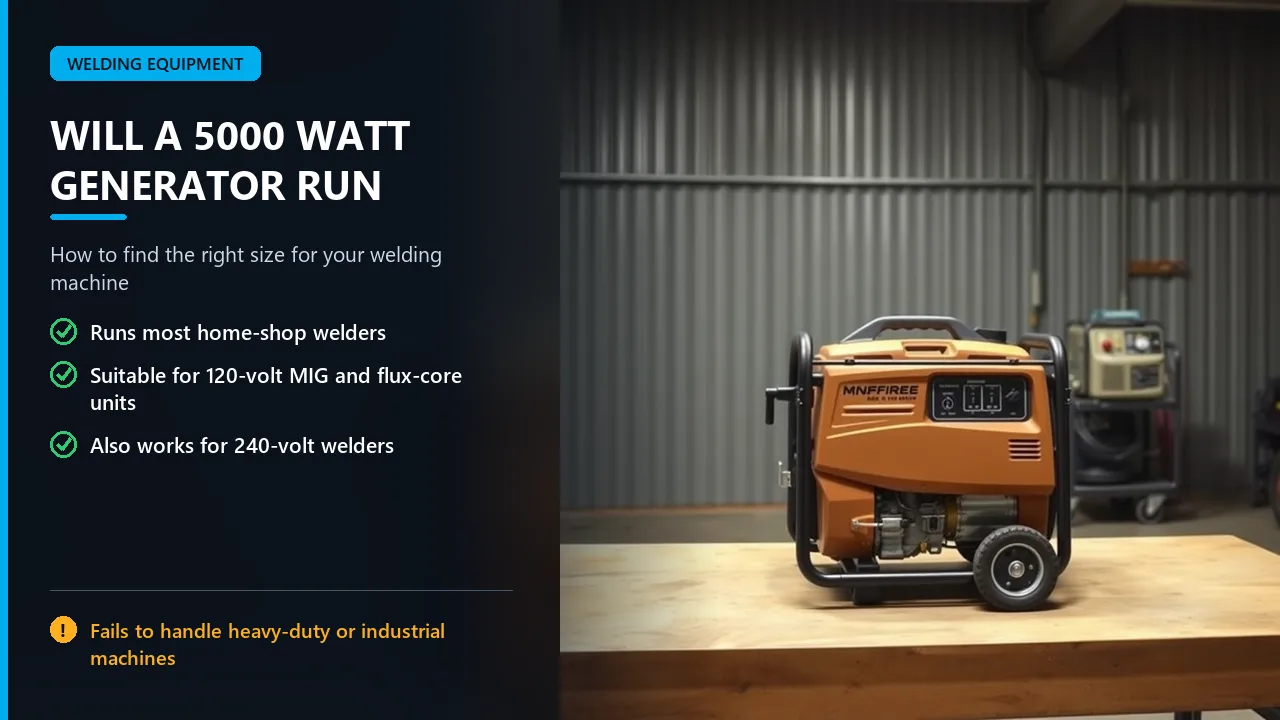
Direct answer, stated up front: yes, a 5,000-watt running generator will run a welder — but only a welder whose actual power draw stays under that running rating, and for most home-shop machines the draw has to land under roughly 4,500 watts to behave properly. That covers a huge share of real machines: most 120-volt MIG and flux-core units in the 90-to-140-amp class, and 240-volt welders up to the 180-amp class. It does not cover heavy-duty or industrial machines, big transformer stick units, or any welder whose nameplate input demand exceeds what the generator can deliver in its running, not surge, rating.
Below is the whole reasoning — what the nameplate actually tells you, what a 5,000-watt generator produces in amperage at each voltage, which welders fit and which do not, the alternatives at 2,000 to 4,000 watts, the clean-power and altitude realities, and the field behavior that keeps a generator-fed arc alive. Hal’s story ends well because he stopped guessing; your version can start with the numbers instead.
Quick Note: The deciding number is the generator’s running (rated/continuous) watts, not the surge/peak watts printed in bold on the box. Every conversation in this article uses running watts, because running watts are what hold an arc.
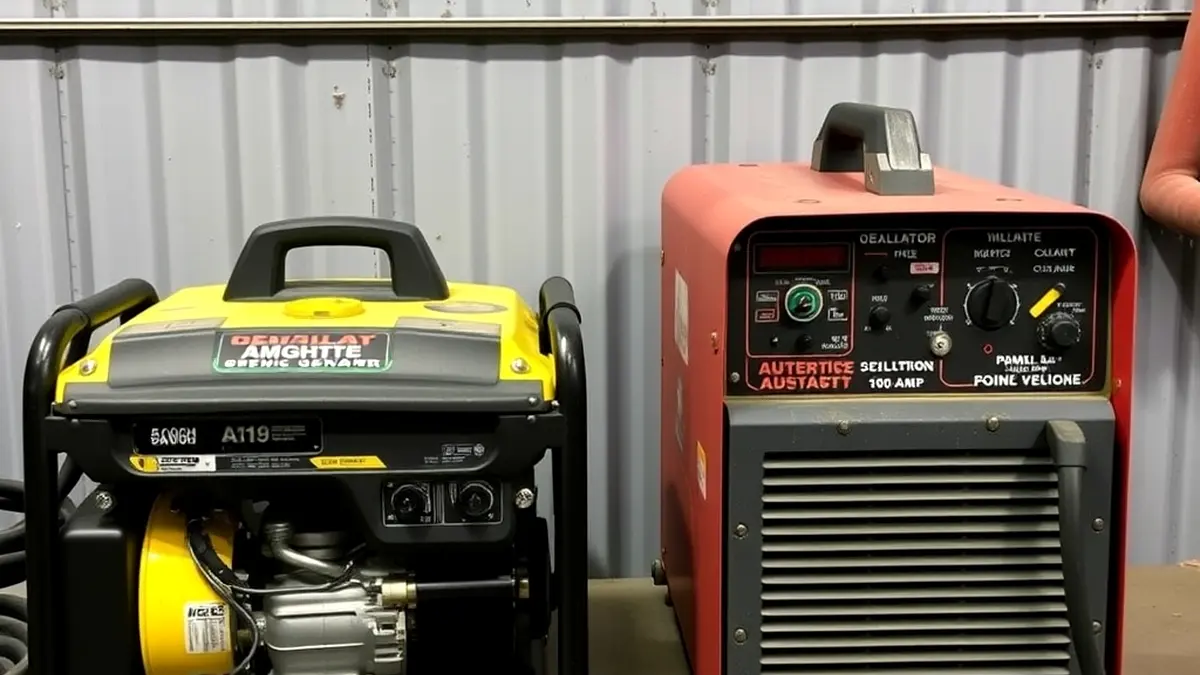
Scan to the row that matches your machine. The middle row is the one everyone asks about, and the column on the right separates “yes, comfortable” from “no, not this one.”
| Machine class | Typical draw | Will a 5,000W running generator handle it? | Realistic verdict |
|---|---|---|---|
| 90–110A 120V flux-core | ~1,500–2,500W | Easily | Yes, with huge margin |
| 120–140A 120V MIG | ~2,800–3,600W | Yes | Yes — comfortable for 120V input |
| 140A dual-voltage at 240V | ~3,600–4,300W | At the edge | Yes, with margin already counted |
| 180A dual-voltage at 240V | ~4,500–5,200W | At or past the line | Marginal — reduces output or upgrades generator |
| 200A+ MIG / AC-DC TIG | ~6,000–8,500W | No | No — must move up in generator class |
| Industrial / heavy transformer stick | Above 8,000W | No | No — engine-driven welder territory |
What the table makes obvious: a 5,000-watt running generator is a genuine workhorse for the smaller half of the welding market, and a genuine dead end for the hungrier half. The trap is that the same generator that runs a 140-amp MIG all day will let a 200-amp machine die in front of thirty spectators — and it will do it while appearing to be “the right size” to anyone who judged by shelf appeal. Matching your machine’s draw to the running rating is the entire discipline.
Pro Tip: Read the welder’s nameplate input current, multiply by its input voltage, and compare against the generator’s running watts. 240-volt input of 18 amps is 4,320 watts; 120-volt input of 30 amps is 3,600. Same machine, different arithmetic — and both numbers have to beat the generator’s running rating with room to spare.
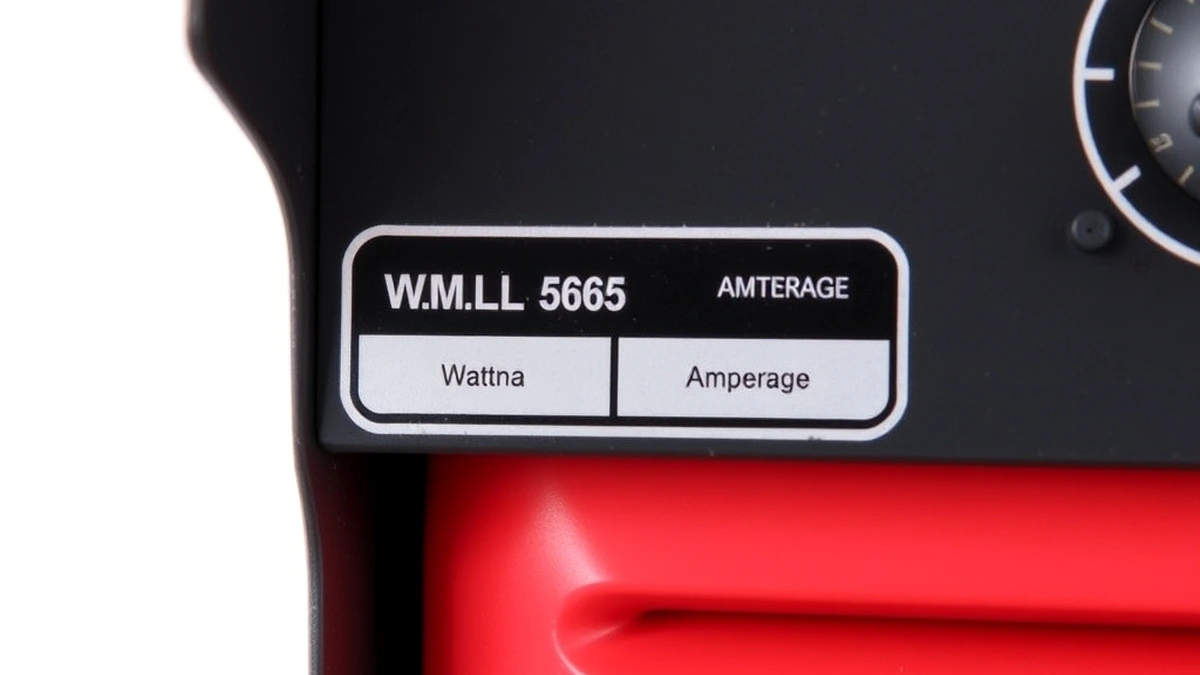
Every generator and every welder speak in watts, volts, and amps, and the three are welded together by one formula that never argues. A watt is a unit of power — the rate energy moves. A volt is the pressure pushing it. An amp is the rate the energy flows. Multiply pressure by flow and you get power: volts times amps equals watts. That one equation decides every generator purchase, because it appears twice — once on the welder’s nameplate and once on the generator’s spec sheet — and the two appearances have to agree.
Take the welder you actually have. If its nameplate says 120 volts and 18 amps of input, the machine consumes 2,160 watts at rated output. If a bigger brother says 240 volts and 24 amps, it consumes 5,760 — already over a 5,000-watt generator’s running rating before you add a foot of cord. Run the multiplication for your own machine before you run the test weld; it costs thirty seconds and it is the same math our how many watts a welder uses article works through in depth across a dozen machine classes.
The “140” or “180” stamped on the front of the welder is output — what the machine delivers to the electrode. The generator only ever sees input. A machine that outputs 140 amps at the arc may pull 15 to 18 amps from a 120-volt supply or 9 to 10 amps from a 240-volt one, and neither input number looks anything like the output rating. People who size generators from the front-panel number overspend or undersize by a factor of two, and undersizing by a factor of two is exactly how a welder on a 5,000-watt generator dies before lunch. Our breakdown of running a stick welder on a generator shows the same trap on the stick side, where the current spikes make the input draw angrier still.
Short Note: Inverter welders are more power-efficient than old transformer machines and draw slightly less input for the same output — but the nameplate still overrides every approximation, and a few extra watts of headroom remains the right habit.
The generator’s capacity is not a blob of watts; it is a fixed number of volts and amps at each of its receptacles, and welding plugs into specific receptacles. Translate the wattage into amperage per outlet and the ceiling becomes concrete.
| Generator running watts | Amps available at 120V | Amps available at 240V |
|---|---|---|
| 2,000W | ~16.6A | ~8.3A |
| 3,000W | ~25A | ~12.5A |
| 4,000W | ~33A | ~16.6A |
| 5,000W | ~41.6A | ~20.8A |
| 6,500W | ~54A | ~27A |
Those two columns read like a map of exactly which welders fit. At 240 volts, the 20.8 amps a 5,000-watt unit can sustain is the boundary: welders drawing 18 to 20 amps of 240-volt input sit close to that edge and need care; welders drawing 25-plus need a bigger set. At 120 volts, the machine’s draw rarely approaches the ~41-amp theoretical ceiling because the generator’s 120-volt receptacle amperage (usually 20 or 30 amps) is the practical limit — a 140-amp welder drawing 17 to 19 amps fits a 20-amp outlet, and most generator-fed work settles there. Divide watts by volts, and every answer in this article is the same table.
Nearly every generator sold prints two figures, and the larger one — surge, peak, or starting watts — is what the box shouts. The surge figure covers a spinning motor’s start-up moment: a compressor kicking on, a saw biting. The running figure is what the set holds minute after minute, and welding is a sustained load, not a start-up moment. A 5,000 surge / 4,000 running generator will start a compressor hard and then run it fine; it will also fold the moment a welder asks for a sustained 4,300 watts over a long bead, because that is the running zone, not the surge zone. When the guy at the counter hands you the box and reads you the big number, smile and ask for the small one.
Quick Note: Welding current is spiky — a dipping rod, a dirty plate, a stitch across a gap all draw momentary surges of their own above the machine’s average. The generator has to hold both the machine’s average draw and the spikes, which is precisely why the running rating needs headroom over the average, never equality with it.
Walking a real 5,000-watt generator through the actual market of welders gives the cleanest picture of where it belongs and where it packs its bags.
The small-to-mid half of the market lives happily under 5,000 running watts. A 90-to-110-amp flux-core machine drawing 2,000 watts has margin to spare; the honest 140-amp 120-volt machines sit near 3,000 to 3,600 and leave real headroom; and a 140-class dual-voltage unit on 240 volts, drawing 3,600 to 4,300, works with the margin everyone recommends. That is the sweet spot of the entire article: if your welder’s input draw is under 4,300 watts, a clean 5,000-watt running generator is the right size, and the machines listed in our 110-volt flux-core welder guide and MIG welders under $500 mostly live in this zone by design.
Push a hungrier machine against the same generator and the signature failure shows up fast: the electrode sticks, the arc pops out repeatedly, and every attempt to restart digs the machine deeper into brown-out protection. That symptom is not a broken welder; it is a supply that cannot hold the arc’s voltage under load. A 180-amp dual machine on 240 volts can draw 4,500 to 5,200 watts — at or past the 5,000-watt running line — so the arc starves, the machine’s input protection trips, and everyone calls the machine bad. It was the generator all along. The same class of machine will run on a 5,000-watt set if you stay at low-to-mid settings and light wire, but that is a compromise with a clock on it.
Industrial and heavy-duty equipment is simply outside the physics. A 200-plus-amp transformer MIG, a full AC/DC TIG at high amperage, and the big transformer stick buzz boxes draw 6,000 to 10,000 watts, which no 5,000-watt generator reaches with a straight face. Running one off a 5,000-watt unit means the machine never reaches full output, the generator smells hot, and the welds look like the arc equivalent of a tired heart. If your machine lives in this class, the honest supply is a larger generator — or an engine-driven welder built for the job, and our review of the Lincoln Ranger series shows what that path looks like.
Important: “The machine is only rated 140 amps, why would it need more?” The output rating is not the deciding number; the input draw is. Verify it, because welders that share a nameplate output class can differ in input draw by a thousand watts depending on efficiency and electronics.
People phrase the whole topic as “will 220 work on 5,000 watts?” and the truthful answer is that a 220/240-volt welder on a 5,000-watt generator works only when its input draw stays under roughly 20 amps, because that is the generator’s sustained capacity at 240 volts. The welder’s voltage does not decide anything by itself; the voltage times the machine’s current decides it. A small 240-volt MIG drawing 10 amps runs as if the grid were present. A 240-volt transformer stick drawing 30 amps does not, and no number of adapters changes that.
Most mid-size portable generators carry a single 240-volt receptacle rated 30 amps — typically an L14-30 twist-lock or a 14-50 four-prong on the larger units — and welders in the 6-50/14-50 plug families reach that receptacle through a short, properly made adapter or a plug change on the whip. The same guidance that governs a shop outlet applies on a trailer: the receptacle rating, the breaker on the generator, and the cord gauge all have to agree with the machine’s input, and our welder outlet guide maps the connections whether the far end is a wall or a generator panel. The generator side adds one rule the building never has: never stack adapters to “fix” a mismatched plug, because the amperage ceiling of the weakest link — usually the smallest receptacle gauge in the chain — is the whole supply’s ceiling.
Pro Tip: On a 120-volt-only welder, hunt for the generator with the 30-amp RV-style outlet (TT-30R). It gives a 140-amp machine’s 17-to-19-amp draw generous headroom over the 20-amp household outlets that crowd smaller units.
Concrete scenarios beat abstractions, so here are the three machines that actually fill trailers and garages, and the verdict for each on a 5,000-watt running generator.
Scenario one — 120-volt flux-core, 100 amps of output. Draw sits around 2,000 to 2,500 watts. Verdict: works with colossal margin. The generator loafs, the arc is stable, and a grinder can ride along if it is not running at the same second as a weld. This is the machine that makes a 5,000-watt generator feel oversized — which is another way of saying “fully adequate.”
Scenario two — 140-amp 120-volt MIG, the market’s most common box. Draw hits roughly 3,000 to 3,600 watts at its top settings. Verdict: works properly, with the margin recommended by every sizing guide, provided the machine’s plugging uses the 20-or-30-amp 120-volt outlet and not a daisy-chained adapter. The arc stays stable through long beads; the generator carries the load at a comfortable 60-to-75% of its rating.
Scenario three — 180-amp dual-voltage MIG at 240 volts, full output. Draw reaches 4,500 to 5,200 watts. Verdict: at or past the line. The machine will start, weld light metal, and generally behave at reduced settings — and it will fail hard, with arc popping and input protection tripping, if the job calls for everything it has. The honest corrective is to step the generator to 6,500 watts running, or run the 180 machine at 120-volt settings for thin work only. Our generator sizing for a 140-amp welder covers the wattage computations in the same language for the machine right below this class.
Quick Note: Every welding session is a load profile, not a single number. A long drag-out fillet loads the generator continuously; a run of short stitches lets it rest. The honest sizing uses the continuous case, because that is the one that fails at the wrong hour.
Skip the guesswork and do this field check before buying or renting anything.
Step 1 — find the nameplate. Usually on the back or side of the case, the sticker lists input voltage and input amperage at rated output. Photograph it.
Step 2 — multiply. Input volts times input amps equals input watts at rated output. A label reading 120V/15A is 1,800 watts; 240V/20A is 4,800.
Step 3 — add a working margin. Multiply by roughly 1.3 to cover surges, cord losses, heat, and altitude. That product is your honest generator floor in running watts.
Step 4 — compare against the running rating. If the welder’s marginal draw plus your working margin stays under the generator’s running watts, the pairing works. If it lands on the line or over it, treat the answer as “no” and size up.
That is the whole system. It is the same arithmetic every generator-sizing guide uses, and it takes less time than unpacking the machine. Where the running-watt figure lives on the generator’s own spec sheet — and how to tell an honest one from a marketing one — is the subject of the next two sections.
Short Note: Running the same four steps for the breaker, instead of a generator, is exactly what our breaker sizing guide does — the math is identical because both are supply questions.
A 5,000-watt generator is one rung on a ladder, and knowing the neighbors says when the middle rung is the right one.
| Generator running watts | Amps at 120V / 240V | Welder class it covers | Typical verdict |
|---|---|---|---|
| 2,000W | ~16.6A / ~8.3A | 90A and under | Tiny machines only — a 2,000-watt unit runs a small flux-core unit at low settings, and little else |
| 3,000W | ~25A / ~12.5A | 110–120A | Light MIG and flux-core; marginal for anything calling itself 140 |
| 4,000W | ~33A / ~16.6A | 120–130A at 120V | A 140-amp machine runs only at reduced settings |
| 5,000W | ~41.6A / ~20.8A | Up to 140A robustly; 180A at 240V only at reduced settings | The practical home-shop sweet spot |
| 6,500W | ~54A / ~27A | 180–200A | The comfortable pick for the hungrier half of the market |
Read the ladder and the pattern is clear: each rung roughly covers the class of machine one notch below its name. The 5,000-watt unit is the sweet spot because it covers the enormous middle of the market — the 90-to-140-amp machines that fill trailers and garage corners — without the weight and fuel bill of the 6,500-plus units. If your machine is small, the 3,000-watt rung genuinely saves money and weight. If your machine is big, the 5,000 rung is the wrong place to stand, and pretending otherwise is how welders die at the fence line.
Important: A smaller generator is lighter, cheaper, quieter, and easier on fuel — so the temptation is always to buy down. The penalty for buying down on a welder rig is not gentle; it is a machine that never behaves, and an afternoon spent troubleshooting an arc instead of laying welds.
The watts may reach the receptacle, but the amps travel through cables, and every link in that chain is a place where the plan goes wrong. Cord math is the same everywhere in this book of lessons: every foot of undersized copper is a resistor, and a resistor between a 5,000-watt generator and an arc is a welder that acts weak.
| Amperage the load pulls | Run under 50 ft | Run 50–100 ft |
|---|---|---|
| Up to 15A | 14 AWG | 12 AWG |
| Up to 20A | 12 AWG | 10 AWG |
| 20–30A | 10 AWG | 8 AWG or better |
A 140-amp welder drawing 9 to 10 amps on 240 volts is a light load for any decent cord; the same machine on 120 volts at 17 to 19 amps starts to care, and a long 16-gauge extension on a 20-amp draw can drop a handful of volts and heat up audibly. The rule that ends the argument: size the cord to the machine’s input amperage, and to the length of the run. Keep the cord uncoiled while running so it sheds heat, keep connectors rated for the amperage, and never join extension cords end-to-end like holiday lights across a job site. Every joint is a resistance and every resistance is a voltage drop looking for a victim.
Short Note: Twist-lock connectors earn their place in a field rig — a quarter turn and they hold through engine vibration, where straight-blade plugs wiggle out mid-pass. If your machine’s whip uses a straight blade and you reseat it constantly, converting to a locking connector is a fifteen-minute job and a season-long blessing.
One correct, rated adapter cable between the generator’s receptacle and the welder’s plug is the entire solution; a chain of household adapters is a fire waiting for a spark-producing audience. Read the plug codes — an L14-30 on the generator, a 6-50 or 14-50 on the whip — and buy a purpose-built cable rated for the lowest amperage in the pair, never a discount-rack assembly of mismatched blades. Devices that carry certification marks from recognized testing laboratories such as UL have been tested for exactly the duty you are about to hand them, which is more than a three-for-ten set can claim. Our welder outlet guide maps the plug-and-receptacle families whether the far end is a wall or a trailer deck.
Once the wattage math settles, the purchase sits on its own scale: new, used, or rented. Each carries a different kind of risk, and each is right for a different owner.
New buys the warranty, a spec sheet you can trust, and out-of-the-box performance; on a 5,000-watt unit the investment is real but bounded, and a manufacturer’s warranty is worth exactly the value of one mid-winter failure. Used buys savings and instantly inherits someone else’s history — the classic used-generator bet is a unit bought on sight that sags 10% under welding load on its first job because the previous owner sold it for that reason. The defensible used-buying habit reads the unit before the money moves: run it, load it, watch the voltage under a real bead, and check oil, compression, and governor response. Rental buys correct capacity for a specific job with zero capital, and it is the honest answer for a one-time project — the rental house also owns the maintenance, which is more than you can say for a lot of used inventory.
If the rig rolls weekly, buy new and match the recommendation. If it rolls twice a year, rent and let the rental company own the engine. And if you are buying used, budget the same inspection time you would spend on the welder itself — because on any rig, the value of the equipment lives in the spec sheet plus the service history, not the decal. The same reasoning runs through our look at whether Harbor Freight welders are worth the money: the cheap route is a fine route when the spec sheet is honest, and a gamble when it is not.
Quick Note: Whatever the path, buy with an eye on tomorrow. A 5,000-watt unit is the right answer for the machine you own today; if next season brings a 180, the 6,500-watt class is the comfortable home, and shopping once for the larger set avoids buying twice.
Modern machines have changed the generator conversation in two ways: inverter generators deliver waveform quality the older units never could, and inverter welders tolerate supply imperfections better. Both matter to the will-it-run question because power quality — not just quantity — is what keeps an arc alive.
Total harmonic distortion, or THD, measures how far a generator’s waveform strays from a clean sine wave. Wall power stays near 3 to 5%; cheap conventional generators can run 6% to double digits, and welding on that dirt shows up as a wandering arc, multiplied spatter, and control boards in inverter machines that act possessed. The standard line for sensitive electronics and welding is under about 5 to 6% THD, and the modern inverter generators — which synthesize a clean wave electronically — deliver 3% or better, visually indistinguishable from the grid. If your generator’s spec sheet prints a THD figure under 5%, buy with confidence; if it stays silent on the subject, assume the worst and keep expectations on the floor.
Inverter welders themselves are part of the same modern wave. Because they convert input power internally and regulate precisely, they draw slightly less input current for the same output than old transformer machines — a few percent that, on a machine already sitting near the 5,000-watt line, can be the difference between “works” and “doesn’t.” The old advice to multiply inverter welders’ draw by 1.5 exists because their electronics were once believed to draw heavy surge peaks; practice shows a modest margin, not a doubling, is the honest number, and the same 1.3 working margin used everywhere in this article covers it. The machines in our beginner MIG roundup nearly all sit in this inverter class, and they pair cleanly with a 5,000-watt clean-supply unit.
Pro Tip: If your welder “ran fine on the house, dies on the generator,” test the generator’s waveform before you condemn the machine. Nine times out of ten the machine is telling you the truth about the supply.
Whether a 5,000-watt generator can keep running a welder is a fuel question as much as an electrical one. A typical gasoline unit in this class carries a 4-to-6-gallon tank, and its burn rate follows the load curve.
| Operating condition | Typical burn (gasoline) | Runtime on 5-gal tank |
|---|---|---|
| Light welding load (small MIG, half settings) | ~0.4–0.6 gal/hr | ~9–12 hours |
| Moderate welding load (140-amp class at working settings) | ~0.5–0.8 gal/hr | ~7–10 hours |
| Heavy load (near rated capacity, long beads) | ~0.8–1.1 gal/hr | ~5–7 hours |
The widely quoted figure of “9 to 10 hours” for a 5,000-watt unit is real, and it belongs to the light-to-moderate columns of this table — the usual condition of a 140-amp machine doing ordinary work. Plan a fuel run into a full day of heavy welding, because the tank capacity and the burn rate meet sooner than the decal implies. On a farm or site where fuel is thirty minutes away, the reserve can decides whether the rig finishes the job or drives off for gas mid-weld. The practice habits around fuel — check the tank before every session, stabilize between jobs, never run the unit dry under load — are the same ones our welding safety guide treats as non-negotiable, and they cost more reputations than wattage ever does.
Short Note: A visible fuel gauge is worth real money on a welding rig. Output sags as the tank empties, and a machine at the edge of a sagging supply is a machine mid-failure.
The last mile of generator-fed welding is behavior, and behavior is where the margin gets spent or saved.
Generators derate with elevation — roughly 3% per 1,000 feet, because thinner air feeds less oxygen to the engine — and with ambient heat, which leans a carbureted mixture and softened output. A 5,000-watt unit at 6,000 feet of elevation is effectively a 4,100-watt unit, and a 140-amp welder at the edge of its envelope feels exactly that difference. If your site sits high or hot, either move down a class of work or up a class of generator before the surprise happens. The same derating math governs the whole rig, machine and supply alike.
Two habits decide whether a generator-fed welder lives a long life. First, never start or stop the generator with the welder connected and energized — let the engine stabilize before connecting, and disconnect before shutdown, because the transients on both ends are what control boards hate. Second, disable eco-throttle while welding: the load-adaptive speed hunting of eco-mode introduces its own voltage wobble at exactly the moment the arc needs stability. Set the throttle steady, weld, and let the machine work in its natural rhythm. The same discipline around extension cord quality and keeping the cord uncoiled so it sheds heat appears in detail in our welding shop safety guide, and the full cord-gauge table lives in the companion article on sizing a generator for a 140-amp welder.
A 5,000-watt generator running a 140-amp welder at 70% of rating leaves no honest room for a grinder or compressor on the same second. The classic broken promise of field work is the grinder and the arc running together — two spiky loads, one voltage regulator, and the arc losing. The fix is sequencing, not a bigger spend: prep with the grinder while the welder rests, weld in clean bursts, and let the generator carry one demanding load at a time. It is the least expensive performance upgrade on any rig.
Quick Note: If you catch yourself planning accessories on top of an already-full welding load, the honest answer is not a smaller accessory; it is a bigger generator, or a second unit, or a careful schedule.
A welder’s duty cycle — the fraction of a ten-minute window the machine can weld before its thermal protection wants a break — quietly shapes the generator question too, because it defines the difference between the machine’s average draw and its peak draw over time.
A machine running at 40% duty cycle welds four minutes and rests six, which gives the generator’s engine and alternator a constant rhythm of load and recovery. A machine pushed into continuous work — long structural seams, clamp-and-drag repair beads — welds continuously, and the generator never gets the rest beat. The thermal consequences compound in both directions: a welder at the top of its settings generates heat fast, and a generator held at high output runs hotter, and both lose margin the longer the session runs. That is why the sizing consensus treats the continuous case as the honest one, because the continuous case is the one that fails at the wrong hour, and why the same input-amperage machine can be completely comfortable on a 5,000-watt unit for stitch work and nerve-wrackingly close for production drag-outs. The machine-side half of the same conversation is covered in our guide to increasing welder duty cycle, which explains how settings, cooling, and technique push the time limit around.
Read your machine’s duty cycle numbers the way a generator owner should: as a description of how hard the supply is going to work. A hobby machine with a 20% duty cycle at maximum output will spend most of its day resting, and a correctly sized 5,000-watt unit glides. A machine rated 60% or 100% at the same dial is a continuous-load customer, and the generator’s own running-hours and thermal capacity are now the conversation. Match the supply’s continuous capacity to the machine’s continuous appetite, and the pairing holds through an eight-hour day; ignore the time dimension and the physics settles the argument without you.
Short Note: Duty cycle is stated at a specific output and ambient temperature. The same machine at a lower setting often runs a longer cycle than the sticker claims, and the opposite is true in summer heat — adjust the working assumption for the real work, not the brochure.
Every failed pairing I have seen traces to one of these. Treat them as the checklist of what not to do.
Mistake one — reading the surge watts. The box shouts 5,000 (surge), the fine print says 4,000 (running), and the welder discovers the difference by dying.
Mistake two — sizing on the machine’s output rating. “It’s a 140, it should run on just about anything” is the sentence that ends in an afternoon of arc-popping. Input draw decides, and output is not input.
Mistake three — the adapter chain. A nest of household adapters between a generator and a welder turns every joint into a resistor and every resistance into heat. One correct, rated adapter cable is the entire answer.
Mistake four — treating outlet amperage as unlimited. A generator’s sustained amperage at the receptacle is the hard ceiling, and a machine that needs 24 amps on a 20-amp outlet needs a different plan, not a bigger fuse.
Mistake five — ignoring power quality. The perfect wattage number means nothing on a dirty wave. THD under 5% or buy a story about the arc.
Mistake six — believing the machine is broken. The number-one cascade in field welding: undersized supply → arc pops → machine condemned → generator bought bigger by accident. Diagnose the supply first.
Pro Tip: Measure the generator’s voltage under load with an actual weld before you trust a pairing. A 240-volt receptacle holding 230-plus volts beneath a full arc is a healthy supply; a set sagging to 210 is telling you the truth about its limits before your welder does.
There is an honest set of conditions under which the answer to “will a 5,000-watt generator run my welder?” is “no,” and knowing it saves a wasted purchase. Any welder whose input draw crosses about 4,500 watts at your working settings is outside. Any site above significant elevation, in extreme heat, or running continuous production load is closer to the edge than the rating admits. And any machine whose nameplate recommends a larger circuit than 5,000 watts of running supply can sustain — a 200-amp transformer MIG, a big AC/DC TIG at top output, an industrial stick unit — belongs on a larger continuous supply, not on culinary optimism.
For those machines the professional answer is the next class up — a 6,500 or 8,000-watt running unit — or, for genuine field work, an engine-driven welder built to make weld-power directly rather than through a utility generator and a separately-fed machine. The engine-driven route is more money and more machine than a 140-amp welder needs, which is why this article’s answer for the mid market is “yes, 5,000 watts runs it,” while the honest coda stays the same: the machine’s input draw is the law, and every other number is commentary. The manufacturers that live in this territory publish the primary-source specs that settle the debate: Lincoln Electric documents input requirements for every machine family it sells, and Miller does the same for its comparable models — both are the kind of reference that turns a trailer-deck argument into a lookup. Our review of the Lincoln Ranger 330 and the comparison of budget welder brands both circle the same truth from different sides: buy for the machine you will actually run, not the machine you wish you had.
Important: A generator is not a battery that “shares” capacity; it is a source whose running rating caps everything downstream. When the sum of the welder, the extras, the derates, and the cord losses exceeds the running watts, the system is over budget the moment the arc strikes — and no adjustment to the machine changes physics.
The “will a 5,000-watt generator run a welder” question never arrives in the abstract. It arrives on the bed of a truck, outside a barn, or at the edge of a concrete pour, and the answer wears different clothes in each place.
The farm version. A rancher with a 140-amp flux-core machine welds gates and trailer brackets in the yard, fifty feet from the barn. His 5,000-watt generator carries the load at a friendly 60% of its rating, the clean-supply model keeps the arc stable through long beads, and the pairing works so well he forgets the generator is there. The margin is the story: on a machine that draws 2,500 to 3,000 watts, a 5,000-watt running unit is exactly the right amount of honest headroom, and the rig becomes background equipment.
The shop version. A fabricator runs a 180-amp dual-voltage MIG off a 5,000-watt set while the shop waits for a panel upgrade — then discovers the machine at full output on a long drag-out fillet is past the generator’s running line. The arc pops, the machine’s protection trips, and he works at reduced settings until the 6,500-watt unit arrives. The lesson lands softly: the 5,000-watt unit was never the wrong generator; it was the wrong generator for that machine at that setting, and the difference between the two statements is the whole article.
The site version. A contractor’s trailer carries a 120-volt MIG and a 5,000-watt generator for light strap welding on a construction site. The machine draws 3,000-plus watts on the 120-volt side, the set coils through it at a healthy pace, and the day works — until his partner grabs the grinder at the same second as a weld. Two spiky loads on one regulator, and the arc loses the fight. The contractor learns sequencing on site, which is where most field lessons are actually taught.
All three stories end in the same place: the machine’s input draw was the law, the margin was the difference between trust and theatrics, and the 5,000-watt unit earned its living exactly where the sizing table said it would. The same pattern runs through every rig that gets bought right by accident — and this article exists so you can buy it right on purpose, the way Hal eventually did after an afternoon wrestling an arc no undersized supply was ever going to hold. The National Institute for Occupational Safety and Health documents welding work practices at cdc.gov/niosh for anyone taking the field side of the trade seriously, and the machine-selection logic in our MIG, TIG, and stick comparison applies the same upstream thinking to the welder you pair with the supply.
Short Note: Test every new pairing with a light weld first — one short bead at moderate settings — then lean on it only after the arc proves the supply. That two-minute habit catches a bad pairing before a paid day depends on it.
The electrical match is half the reliability question; the engine is the other half, and a generator’s engine has a hard life — it runs hot, it sits idle for weeks, and it loves to be neglected.
Portable generators run small four-stroke engines with a dipstick, an air filter that eats site dust, and a spark plug that fouls on short-hop duty. The ritual is short: check oil before every session, clean or replace the air filter on a schedule that matches how dusty the site gets, gap and replace the plug once a season, and watch the governor linkage for stiffness. An engine slipping 200 rpm because of a sticky throttle arm is starving the same welder your headroom margin was protecting; voltage stability starts at the points and plugs. The National Fire Protection Association publishes equipment maintenance and fuel-handling guidance that applies directly here — its standards library is where professionals go when the question is “what is the actual rule for handling this machine and its fuel?”
Beyond the engine, the electrical side wants its own monthly visit with a multimeter: voltage at the receptacle (240 volts should hold in the 230-to-250 range unloaded and sag only a few percent under a full bead), outlets examined for scorch or looseness, breakers confirmed to reset cleanly, and the frame-ground connection re-tightened. A generator sagging more than it should is reporting a regulator, AVR, or winding problem before it fails completely — catching it at the outlet with a meter costs nothing and prevents the one failure that ruins a paid day. The Department of Energy’s energy.gov resources on portable power and small-engine efficiency are a solid free reference for the conservation side of the same habit.
Pro Tip: Store the rig with fuel stabilizer and a full tank to keep condensation out of the system, and let the authorized oil interval run no longer than the engine-hour schedule says. Trailers kill generators in storage far more often than sites do.
There is a version of this question that involves the house itself: a welder in the garage, a 5,000-watt generator on standby, and the tempting idea of wiring the generator into the panel so the shop “has power on its own.” That wiring is a specific safety conversation, and it is not optional.
Backfeeding a house panel through a generator inlet without a transfer switch or mechanical interlock can energize the utility line — a deadly condition for lineworkers and a violation in most jurisdictions. The legal architecture is simple: a transfer switch or interlock makes it physically impossible to feed the panel from the generator and the utility at the same time, and once that exists, the shop can safely run welder, lights, and compressor from the set during an outage. The OSHA welding and cutting standard at osha.gov and the federal regulation at eCFR Section 1910.252 both take the workplace supply seriously, and the interlock is not optional hardware in that picture — it is the difference between a rig and a liability. For the shop-side wiring itself, our breaker sizing guide and the wire gauge reference carry the electrical side of the same question with the numbers attached.
Important: A generator tied into a panel feeds breakers that may exceed what the generator can sustain; the panel’s breaker settings do not protect the generator from being overloaded. Size and sequence the load for the generator’s running watts, and treat the interlock as the boundary between “wired up” and “wired safely.”
Before the money moves or the trailer is loaded, run this short checklist. If every box checks, the pairing is done and you can stop second-guessing it.
Seven questions, none of them hard, all of them answered on stickers and spec sheets. That is the entire gap between Hal’s wasted afternoon and a rig that never thinks about its own supply. The same checklist, applied to the machine side, is the reason our roundup of the best 110-volt flux-core welders and the best MIG welders under $500 list power requirements next to every pick — so the generator decision comes bundled, not bolted on later.
Pro Tip: Save the two photos to your phone. Next season, when you are staring at a different machine in a store, the old nameplate and the new one settle the comparison in ten seconds — no memory required.
Yes — this is the pairing the question is about, and a clean-supply 5,000-watt running generator holds a 140-amp welder at working settings with the recommended margin, as long as the machine’s input draw stays under roughly 4,300 watts and nothing heavy shares the second of the weld. The same machine leans harder at full output on a hot or high site, so keep the honest margin before the arc.
Only at reduced settings, and only on a 240-volt 180-amp machine whose input at those settings stays under the generator’s running capacity. At full output a 180-amp machine can draw 4,500 to 5,200 watts — at or past the running line — so the arc will pop and the machine’s protection will trip. The comfortable pairing for a 180-amp machine is a 6,500-watt running generator, or run the machine at 120-volt settings for thin work.
A small stick machine in the 140-amp class draws roughly 4,000 watts at output and runs acceptably on a clean 5,000-watt unit — with the knowledge that stick current spikes are the harshest load a generator sees, so the margin gets eaten fast. Larger transformer stick machines are outside the 5,000-watt envelope, and our stick welder on a generator guide walks through the rod-by-rod verdicts.
The answer depends on the machine’s input amperage, not on its 220-volt label. A 220/240-volt welder drawing 20 amps needs a generator sustaining roughly 20.8 amps at 240 volts — the 5,000-watt rating — while a 240-volt machine drawing 30-plus amps needs a unit sustaining 27 amps or better, the 6,500-watt-plus class. Divide the machine’s input amps by the generator’s sustained 240-volt amperage and the answer writes itself.
Fuel determines it: 0.5 to 0.8 gallons per hour at the loads a 140-amp machine typically draws, so a 5-gallon tank runs seven to twelve hours depending on how hot the work runs. Heavy continuous production shortens that toward the five-hour mark; light stitching stretches it. Bring the correct reserve fuel before a full day depends on it.
Not at the same moment, not with a straight face. A welder at 70% of the generator’s rating plus a grinder’s 1,000-plus watts and surge lands the set over budget exactly when the arc needs voltage. Sequence the tools — grind in bursts, weld in bursts — and the unit serves both honestly. If simultaneous use is a daily need, the generator must be the next class up.
Yes — and this is one of the most common field pairings in welding. A 120-volt MIG in the 90-to-140-amp class draws roughly 2,000 to 3,600 watts, which a clean 5,000-watt running unit holds with real margin, provided the machine plugs into an outlet that can carry its amperage — the 20-amp household outlets on the generator, or the 30-amp RV-style outlet on units that carry one. The same caution that governs the whole article applies: keep the grinder off the same second, keep the cord heavy, and let the generator rest between sessions the way the welder does.
You need clean power; the inverter is the common modern way to get it. A high-quality conventional generator with low total harmonic distortion will weld fine, and a cheap one with a dirty wave will frustrate you regardless of wattage. Inverter generators solve the waveform question outright and add quieter operation and better fuel economy, which is why they are the usual recommendation for welding in the 5,000-watt class. Whatever you buy, read the THD number — under 5% makes the arc happy, and a spec sheet that will not print the number is information in itself.
The answer to whether a 5,000-watt generator will run your welder is a real, useful, positive one for most home-shop machines: yes, if the welder’s input draw stays under roughly 4,300 watts — and that covers 90-to-140-amp machines on 120 or 240 volts, with the cleanest results on a clean-supply unit running at honest margin. It is also a real, honest “no” for the hungrier half of the market: 180-amp units at full output, 200-plus-amp transformer machines, and anything industrial, all of which need a bigger continuous supply or an engine-driven welder.
Two numbers decide everything, and they are both on stickers. The generator’s running watts, and the welder’s input draw — volts times amps. Compare them with a working margin, keep the power clean, keep the fuel honest, and sequence the friendly tools, and the 5,000-watt rig becomes exactly as reliable as a wall socket on a good day. Hal learned that the expensive way, after an afternoon wrestling an arc that his generator was never going to hold. Your version starts with the table at the top of this article and ends, half an hour later, with a pairing you can trust before you ever fire the first bead. If you are still comparing machines and supplies together, our MIG, TIG, and stick comparison and the companion 140-amp generator sizing guide close the loop between the machine you own, the generator you buy, and the jobs both of them run.